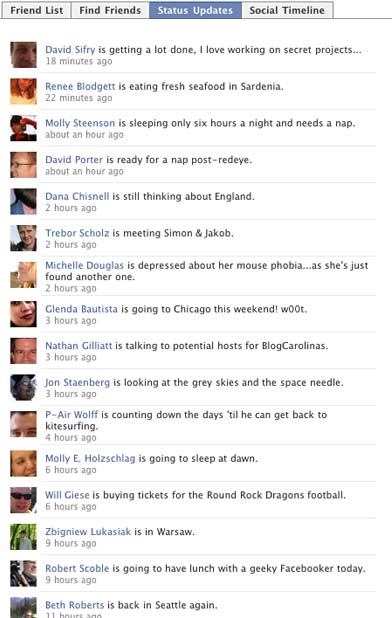
Tuesday, April 27, 2010

Social context, Facebook Likes, activity and action streams

This post began as a comment on the following post by Adina Levin, but quickly became too long, so I am posting it here instead. Read Adina's post on social context first (excerpted here).

Where is social context?
In yesterday's post on the problem with Facebook Like, I wrote that Facebook is trying to be the sole provider of social context. This got me thinking about the various places that social context may be represented in a networked system:
  1. in the object or message (which ActivityStreams helps enable)
  2. in the context where it is created
  3. in the contexts where it is seen and used
  4. in each node of the social graph
  5. in sets of social graph elements
  6. in decentralized elements of the social graph (e.g. aggregated/syndicated profile elements)
  7. shared understanding in participants minds
  8. unshared understandings in participants minds
Facebook's model is seeking consolidation in two places. By replacing a metadata-rich, standardized, ActivityStream based representation of the message with a proprietary API call, Facebook is foreclosing opportunities for the adding of context in creation and in viewing and utilization (items 1-3 in the list).


By acting as the sole provider of social graph and profile services, Facebook is seeking to own those aspects of context (item 4, 5, and 6 in the list). Is Facebook doing anything to enable the exchange of subsets? (item 5 in the list)

________________

What is context? Is it a matter of where or what or something else?
Interesting post — it raises for me the question: What is context? or perhaps, what is the value of context. I am guessing that context means original context, but that begs the question: What's the value of preserving original context? And in the question of context is the presupposition that shared context is valuable (shared context or shared understanding) — but that is a normative claim and the post also argues for diversity and difference.

Several kinds of original context then spring to mind: context tied to to original intent; context tied to original audience addressed; context tied to object references; context tied to linguistic references; context tied to original activity or practice; and context tied to social or public in which the content is produced.

Any one of these may arguably supply context, if context is meant to include:
  • what does the author/contributor mean (to be doing, saying?)
  • what does the content mean to communicate (internal references, external references)
  • what is the content's social status (what social or audience does it tacitly address, and what contribution does it make to what practice within that context)
  • what routine practice does the content refer to or belong to, that might help in understanding its meaning
  • how might one respond (convention, activity, situation, and other kinds of interpretive context external to the content)
  • who is involved (audience context so important today because intended audiences are always involved or presupposed)
  • there are certainly others

On the loss of context
As I'm not a huge fan of the value of content of original production, being rather more interested in creation, production, interpretation (re-contextualization), I don't mind loss of context as I believe:
  • that there's no particular normative privilege involved in original intent — the contribution was made online and w some understanding of what this results in!
  • there's no normative claim in consensus or agreement, or in other words, the original context doesn't preserve truth or rightness of interpretation; the contribution is made online and thus w an expectation of multiple uses and interpretations
  • neither the intentions of the contributor nor the interpretations of the reader supply "truth" — the online world is a communication space in which contest and commentary are assumed — and therefore context as a supplier of original meanings vs context as a referential system that informs interpretive schema are each valid forms of context

Which leads me to believe that context needs further critical reflection. What about context is so important?

An alternative to context: frames, and communication and action
Systems theory provides one way around this — communication. A difference is a difference that makes a difference. The question, then, for social interaction design, would be: what action is possible, what communication can be made more probable?

I would then (no surprise here) nominate different types of action, activity, and social practices as contextual frames of reference, from local and onscreen user interface selections and actions on up to routinized social practices meaningful only over time and within the shared practice of a number of actors. Both action and communication can be pretty clearly articulated, and neither requires a regression to original context, be that of intent, reference, linguistic claims, or what have you.

I know that this contradicts some of the common assumptions made in system design about context. But I don't think we developed these paradigms with social action in mind — I think they were conceived to facilitate effective and efficient user interaction with systems of information (applications). Thus the very notion that original context ought to be preserved is a problematic one — it assumes that meanings ought not go astray of originally intended activity.

We assume, often, that this original context belongs to the object — that, too, is problematic, for much of what is going on is not object centric but is embedded in ongoing communication and social practices (actions).

An example: games and rules
Game rules, for example, better supply context to action and interpretation than do objects — and as Wittgenstein showed long ago, such rules are tacit. Frames can refer to other frames — a move may be understood within its application context or by means of its reference to another frame of activity — in this case, the game.

In social gaming, the game itself may be understood by participants as a social pastime in which several members are contesting supremacy, and this in turn may be a social interaction whose consequences are known only to a small group of individuals in which long-standing social contest for status is re-enacted repeatedly by gaming (game within the game).

Thus the entire question of context may be reframed in terms of action and communication, each of which can involve application-specific meanings on up to social and cultural references. Context might then be better understood within the practices that reframe and recontextualize online contributions, thus permitting ongoing action and communication. Social theory doesn't have a special place for original context, for action supplies its own context.

Practical reflections: activity streams, action streams
Finally, and to get practical for a moment, some thoughts on the matter of activitystrea.ms and Facebook's monopoly of distributed social web activities are warranted. Activity streams supports a broader range of activities than does the anti-social Like. The Like is a one-size-fits-all solution to Facebook's need to venture into social search and socially-contextual advertising and marketing.

Likes eliminate differences of kind and of degree: liking is simple affirmation and association with an item at a minimum, passionate and loyal commitment and dedication at a maximum. But the Like itself neither captures nor represents the degree. And Liking fails to capture nature or kind: does a person Like because s/he identifies with the item, brand, cause, person, etc; own or want to possess it; feel social affinity with the scene or culture it is associated with; mean to gesture or signal activity or engagement (in a game, an offline practice, etc); or what have you.

Activity stream meta data would permit a greater number of updates and qualify them by attributes that supploy more context around the update — which in turn would enable richer and more differentiated interpretations and responses. But these updates, too, are unilateral and monological. Social web updates are a monological system of self-referential declarations. Updates are posted into the open and held open because there is no action possible on them that transforms the update into a move of some kind — a social action.

A transactional system would offer coupling of action updates and closure of activities in which the simple yes/no response essential to social action and communication would be represented within stream updates. A dialogical system would not only solve some of these context problems (not just the where but the what of social context) but would facilitate forms of social networking around messages themselves: distributed or federated, dis- and re-aggregated.

Activity and action streams might not solve the audience context problem, but would permit greater linguistic differentiation of statement types and corresponding responses (invites: accept/decline; offer: accept/decline; news: like/share; purchase: buy/do not buy; and so on). Language itself supplies context, in its grammar and in its role within communication practices.

The fact that so much social web content is treated as information, not as communication, is re-inforced by the loss of context. But could be addressed if we were to standardize the handling of linguistic types and enable reciprocation — or response. The fact that present-day streams now dominate social web activity just seems to beg for this solution of transactionality around coupled messages.

Labels: , ,

Monday, April 26, 2010

What's there to like? Facebook Likes and social object relations

Facebook's recent F8 announcements concerning the Like button, connected pages, and Open Graph api have resurrected some discussion around social objects. I wrote last week about social objects from a theoretical perspective, and want to clarify a few top-line points that I think are worth consideration, particularly given Facebook's apparent semantic and social search strategies.

There are two approaches to social objects. One is theoretical, and one is practical. I will only touch on the theory of social objects briefly here, focusing instead on a few practical implications of an object-centric theory.

In Facebook's Open Graph Protocol from a Web Developer's Perspective, Dare Obasanjo does a nice job of recapitulating one view of social objects relevant to Facebook Likes. He cites a post written by Hugh Macleod in 2007: social objects for beginners

The Social Object, in a nutshell, is the reason two people are talking to each other, as opposed to talking to somebody else. Human beings are social animals. We like to socialize. But if think about it, there needs to be a reason for it to happen in the first place. That reason, that "node" in the social network, is what we call the Social Object.
Example A. You and your friend, Joe like to go bowling every Tuesday. The bowling is the Social Object.
Example B. You and your friend, Lee are huge Star Wars fans. Even though you never plan to do so, you two tend to geek out about Darth Vader and X-Wing fighters every time you meet. Star Wars is the Social Object.

In this view, the object structures relations and is the reason for communication. It represents a shared interest, and for all intents and purposes serves as social navigation. Tags are a similar kind of navigation, useful for finding people with a common interest. And this would seem to be the purpose of Likes on Facebook: a digg-like vote of interest that facilitates people finding and creates possibilities for connection.

But I disagree that the object of shared interest is necessarily the reason for interaction and the object of communication. Objects do not create reasons for connection, nor do they ground communication and interaction. I believe it's the other way around. Communication and interaction may take up objects as a topical theme, but the interest is as much person to person as it is person to object. You may invite a friend to dinner, but this is not because you are hungry.

Objects do not proscribe and structure social relations — objects are subordinate to relations. And interests between people are relational, not object-oriented. The object may supply a shared topic, object of interest, navigational or activity context, but need not itself be the object of communication. Instead, it facilitates connection and helps to create possibilities for communication.

The issue I have with the social object description cited above is that it conflates object and motive. Objects are viewed as causal, of social interaction and social relations. I don't see how we could ground social interaction in objects, or even object worlds, in a manner sufficient to the psychological complexity of human social motives. Objects are not equivalent to the relations in which they are taken up.

In fact, one of the oft-cited theorists of social objects, Karin Knorr Cetina, makes this very point:

Objects of knowledge, the ones important in the present context, are characteristically open, question-generating, and complex. They are processes and projections rather than definitive things. In our interpretation, objects of knowledge seem to have the capacity to unfold indefinitely; in this sense they lie at the opposite end from pure tools and commercial commodities.

Her paper is about object worlds — she uses the example of day traders and stock market representations — not about objects as things. I think we may have misread her discussion of objects to be about things, when in fact it is about relations we take up with things, their meanings, and their representations.

Nor do I think that objects completely supply context, for context in social interaction, too, is relational. If you invite your friend to dinner, two contexts of social interaction are now relevant: the dinner as object, and the invitation as social action. Action can as easily supply context around social objects as any objective relation, or objective property. This is the approach taken by activity streams, and the reason that activity streams supports more than one expression of action. Liking alone risks digg-ification of shared social interests, and a loss of intent and meaning.

Adina Levin makes this point in a post about the Like

But that's what Facebook's "Like" gets rid of. See, there's an alternative vision about social context. And that is that Facebook is your one and only source of context. Thomas Vanderwal suggests, in the discussion of Facebook's recent announcement, that Facebook is not doing such a great job of this today: "The social graph is dangerous without context and much more dangerous w/ partial context." ActivityStreams fosters competition among services that want to provide social context of various sorts, and Like forecloses that competition.

But it is not only context around social objects that is lost, as Vander Wal suggests. It is loss of action, too. Which is one reason for my interest in action streams. Action streams would not only be like-able social objects; they would be actionable social objects. Actionable social objects not only permit more linguistic and expressive (e.g. gestural) actions — invites, offers, announcements, etc — they capture actions on them. For example, an invitation action object could be accepted or declined. This would not only add power to objects, but would capture some social relationality — in the form of reciprocity or mutual interest. Social objects today are still only asymmetrical — two-sided liking is not required for them to serve as interest pivots between people.

There are a couple reasons a double-sided object relation model might be interesting. The first is preemptive: we avoid inundation by system status messages telling us everything about what our friends now Like. The second is enabling: we get better social data. Social data is one of the reasons, if not the main reason, for Facebook's Likes. Facebook will preside over a world of social objects related to people whose interest declarations will given them a reason to advertise by interests served up on page context, within streams (presumably), and across its open graph (presumably) contexts.

As Obasanjo writes:

In the social media space, a few people have focused on the fact that this data is put in place to enable sites to be added to Facebook's social graph. However there is little reason why other social networking services couldn't also read the same markup as a way to add those web sites to their social graph. For example, Yelp is one of the sites that now supports the Open Graph Protocol so when I click like the Pro Sports Club it is added to the list of "pages" I'm a fan of on Facebook. However I could just as easily see that being a [Twitter — Like] button which would add the Twitter account for the gym to my following list along with tweeting to my followers that I liked the gym. It would only take adding a markup element to what Yelp is outputting to indicate the Twitter account of the page being liked. With my Windows Live hat on, I can imagine going to Amazon or IMDB and clicking a [Windows Live — Like] button which would add the movie to my list of favorite things. There are a ton of possibilities this opens up in a totally decentralized way without forcing services or users to be locked into a particular social network.

Unfortunately, the Like represents a pretty thin expression of interest. It fails to capture degrees of interest, or how much you like something; motivation, or why you like it; or social relations, or who you like who likes it. In this, the Like still suffers from the long tail assumption that people are alike who like the same thing — or that likeness between objects is reflected in people who like them being alike one another. Not so, of course, but this is the state of social targeting today (objects of interest are consumer segments; consumers identify with what they like).

It's unfortunate that the Facebook Like is so close to social bookmarking, to retweeting, to diggs and the like that we still cannot capture more of the differences of kind and degree that would make the social web really interesting. But who can fault Facebook for drawing up a semantic and search strategy around the vote of interest. One-click solutions are simple interaction solutions, if not too simple. The majority of advertisers and many marketers, too, will be satisfied with the metrics Facebook will be able to offer about audiences pegged to shared Likes.

But I think that the future of social marketing still resides in a system better able to provide social relational information captured from actions, interaction, and communication. For the grail in social marketing is not the individual, but the social graph, and in particular, who to market to in a social graph. For the power of liking is not just that we like something, but that we like to be liked, too.

Labels: , ,

Friday, June 26, 2009

Digesting public Facebook feeds: implications for brands

Your Facebook updates are going public. In what's being viewed as a response to twitter's success, and as a protective measure taken before a release of revamped Facebook search, user updates will soon come with privacy controls.

From the release:
Today, we're launching a beta version of an improved Publisher--the main place to add content such as photos, videos, and status updates on your home page and profile. The new Publisher has been streamlined a bit, and its most significant improvement is the new Publisher Privacy Control that gives you the opportunity to answer the question, "Who do you want to tell?" as easily as you answer the question, "What's on your mind?"

There's been a lot written for and against Facebook's policy. So I'll refrain from adding to that conversation. But I do want to go down the trail of implications and consequences a bit, as they are interesting. Particularly from the brand's perspective.

Consider what brands might be able to do, if the analytics tools, campaign monitoring and management services, and campaign managers themselves had the resources to go micro:

  • brands will need to develop policies for whether or not to read customer profiles ("profile" here broadly defined as profile, updates, activity feeds, etc)

  • profiles may be collected over time

  • profiles may be analyzed over time

  • social graph information could be used to create social context for a customer: psycho-demographic, consumer interests, personal interests, type of social status, types of online behaviors, type of online personality

  • profiles may be categorized, for a new kind of market segmentation

  • profiles may be used for market research

  • profiles may be used for search engine optimization enhancement

  • profiles may be used for future advertising and marketing approaches (advertising into the feed, flow, stream, status update, etc)


This is not exhaustive. Semantic and sentiment analysis could be applied to profile content. Social network analysis could be applied to friend relationships. Conversational analysis to styles of online talk, and activity analysis to online use habits and behaviors.

But much of this is speculative. Most advertising agencies have yet to establish an ROI for micro-targeted ad campaigns. Most do not have the creative skills or resources (not to insult ad agencies -- you're brilliant!) to craft multi-faceted and multi-wave campaigns for proper targeting to audience sub segments. Imagine A/B testing multiple campaigns designed to reach friends of an influencer by means of the topics and interests in which the user has the most influence... But widespread use of this kind of approach is years down the road. On the road to (economic) recovery, perhaps.

Let's conjecture nonetheless. What would brands have to consider, if they were to make use of information provided by user profiles? Brands would need a

  • policy of use on whether or not to act on information learned

  • they will need a disclosure policy, informing (or not) customers that they use social networking profiles to learn about customers

  • they will need a communication strategy for how to reveal to customers what they know

  • they will need rules of engagement to articulate the ways in which personal information gleaned might be used in communication or service to the customer

  • they ought to develop a code of conduct that would include recommendations for respect of privacy (when users inadvertently reveal or disclose their own, or friends' private activities, news, and so on)


Interesting, too, is who in a company sets these policies? What is the job title? And what does the job description look like? Customer privacy, profile reading, and relationship management would each seem to fall under separate roles today: legal, PR/Marcom, and marketing. Not to mention sales. But the information customers make available could be of substantial value to some brands (entertainment, lifestyle brands especially). Brands that make use of social networking profiles will be those that are capable of translating insights across departments, for a better understanding of who the customer is, how s/he relates to a brand, product, event, or service, and how to reach and communicate with him or her (and friends).

Mashable: Twitter Envy: Facebook Adds Public Content Sharing

Facebook's announcement: More Ways to Share in the Publisher

Labels: , ,

Wednesday, February 11, 2009

Status culture: facebook, twitter, and what they mean

In a series of posts over on JohnnyHolland.org I recently made an attempt at teasing out social interaction design issues specific to lifestreaming. Lifestreaming was last year, and the year before, the sort of rich media, flow-based newcomer to interaction models. Lifestreaming looks like serial blogging, tweeted perhaps instead of blogged, and including pictures, videos, and other rich media (seesmic?). But like all information streams and flow apps, its navigation is limited. The more I thought about it, the more complicated matters became.

The reason was simple, and wasn't really a matter of design at all. It was more a recognition that we are increasingly in the business of applying design to speech, architecture to talk, navigation not only across conversations but plumbing the depths and past of conversation and speech also.

Twitter is the culprit of the 140 character limit, but the social networks (Yahoo 360, Friendster, then of course Facebook) get much of the blame for the status update. Facebook had always been more utilitarian than its chatty and teeny kin. A swiss army knife to the crazy straws and party cups more representative of etiquette on MySpace, Tribe, Friendster, and Orkut, Facebook wisely saw that individual user activity could be made social after the fact if it were printed to a running news and activity roll.

With this, users could look active without having to make the awkward declaration of what they were doing on Facebook, all the time. Users could be seen by others without having to draw attention to themselves. Most importantly, users could seem to be talking even when they weren't.

I find this fascinating. If there's one nugget of social interaction that really needs to be mined and understood — for the purposes of design improvements and next generation social media — this is it for me. Not only the practice of posting status updates (and their variations), but also their supporting practices: following, reading, retweeting, commenting, and so on.

Understanding what "status culture" means seems to me central not only to grasping how our talk tools and services are changing — but also how our communication is changing.

For the next several days I hope to post on "status culture." I will take a different angle on it with each post. The facets I have chosen include:

  • the culture of writing wide, of posting the self, of self-talk in front of others, and of saying little to nobody in particular
  • the design challenge of the user who uses it "whenever I feel like it," of the challenges of designing social interactions for de-coupled structures and unilateralism and asymmetry in speaking and using
  • interpretations of status updating and tweeting from the linguistic and communication theoretical perspectives, including the art of speaking in the third person, of speaking to be seen, of speaking to be found, and of speaking another's words
  • the meaning of status updates and short messaging to different kinds of users, using my social media personality types as a starting point
  • the sociology and anthropology of status updating, including of course influence, social capital, and society as side effect and special effect
  • the psychology of updates, and of the peculiar reversals, projections, passive aggressions and mistaken meanings common to living as sentenced, by sentencing, and by face
This might all seem like overkill, a reading of the 140 character phenomenon that's too close, too analytical, too "too" to be worth the effort. But that would be to take the undertaking too literally. I think it would be fair to say that of all the social practices to emerge since the profile and the social network/graph, this not-so-little ritual has crossed the tipping point and as such indicates what is to come. Social media is leaving the page, conversation is changing, and communication is possibly becoming a symbolic culture in its own right.

Which would be to suggest that communication is no longer just for communicating, that is, reaching understanding with somebody else about something said. For if communication, in the form of short messaging in front of discontinuous audiences, is a new form of symbolic interaction, it is no longer just about the claims raised and resolved by interlocutors (speaking subjects). It is also a means of presencing the self, of self-presentation, of being visible and localizable, of expression but also projection, indication, reference, social inclusion, and much more. In short, a mode of production, not just of the self or subject, but of culture.

And in that, of course, it necessarily attracts commercial interests. Whose attempts to converse, and to be found in conversation, will likely both threaten and extend the possibilities of the form, and the viability of tools and services designed to support it.

I hope you will join me in this project.


Note; This blog post belongs to a series on "status culture." The posts examine status updates, facebook activity feeds, news feeds, twitter, microblogging, lifestreaming, and other social media applications and features belonging to conversation media. My approach will be user-centric as always, and tackle usability and social experience issues (human factors, interaction design, interface design) at the heart of social interaction design. But we will also use anthropology, sociology, psychology, communication and media theories. Perhaps even some film theory.
The converational trend in social networking sites and applications suggests that web 2.0 is rapidly developing into a social web that embraces talk (post IM, chat, and email) in front of new kinds of publics and peer groups. User generated content supplied to search engines is increasingly produced conversationally. Social media analytics tools provide PR and social media marketing with means to track and monitor conversations. Brands are interested in joining the conversation feeds, through influencers as well as their own twitter presence.
This changing landscape not only raises interesting issues for developers and applications (such as the many twitter third party apps), but for social practices emerging around them. So we will look also at design principles for conversation-based apps, cultural and social trends, marketing trends, and other examples of new forms of talk online.
These blog posts will vary in tenor, from quick reflections on experiences to more in-depth approaches to design methodology for conversational social media.

Labels: , , , , ,

Monday, September 29, 2008

OF Lifestreaming and Feeds: Who's Talking?


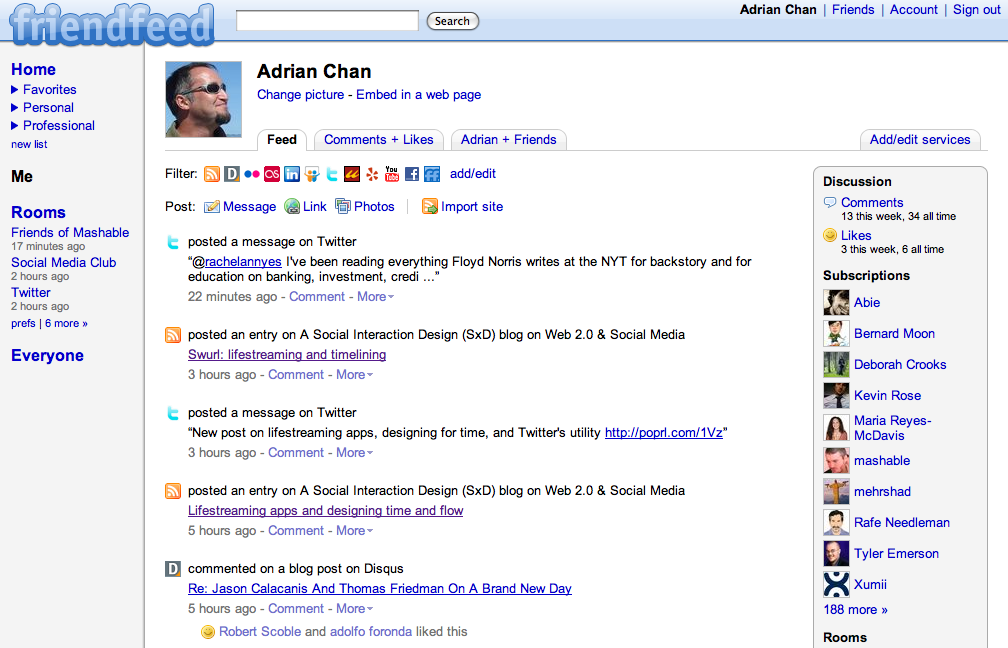
Feeling overfed lately? Sidle up to the trough, there's company here. Yes, subscribing to feed-based applications can be like drinking from a firehose, especially during times like these. When the daily news is itself the topic of presidential campaigns, late-night talk show hosts, politicians (relevant or not, incoming or outgoing), and the news media in general, being on a site like Friendfeed is a bit like Hussein Bolt gesturing for the Jumbotron at the Beijing Olympics.

The echo chamber is also a hall of mirrors.

All social media play some part in mirroring us, reflecting us, whether to ourselves or in front of others. And this doesn't make every social media user a narcissist. It simply admits to the shiny and reflective surface of the social media screen — and to the facts that we like to see ourselves reflected in this screen, and like to be seen by others. It's a particular kind of vanity, of self-image and self-promotion.

I've written about self-image and profile-based social networking, but haven't really applied it to lifestreaming. Of course lifestreaming apps like Twitter also mirror us back to ourselves -- indeed, it would be strange if we didn't see our own tweets alongside others. The production of a self-image online is essential to how lifestreaming works, and why. But oddly enough, original activity feeds weren't posted by users at all.

Facebook can be given credit for having popularized the feed: activity, news, status. Activity and news most of all (Yahoo and Friendster each had shout outs, as did many social networks have a mood option (even blogs have had mood options for inclusion with posting). But Facebook was feeding us system messages (still does). It's Facebook's inspired way of making the site seem more active than it is. Everything a user does is captured, recorded, and considered for re-telling. So in Facebook's case, it often is not the user doing the talking, but the system doing the talking: Facebook was the chamber, and Facebook was the echo.

It is easy to bundle applications together because they use the same forms, or contents. All feeds are not the same, and all lifestreaming services are not the same. Their use of activity streams, status updates, commenting, and variations on posting, etc., suggest common design and architecture in many cases, yes, but these commonalities may conceal substantial differences. A system message that reports on my activity, as in Facebook, doesn't appear to me as something I've said and I won't relate to it as if it were speech. Nor is it addressed to anyone in particular, either. But as it's produced by the system, it may have meta data, and embedded media types, that are better structured than what I may have used in writing/tweeting.

The matter of who's talking might read like a matter of small print and footnotes, but consider the fact that in lifestreaming apps all content is posted by users, and all content is intended by users. In lifestreaming apps users can talk by writing, recording, sharing, and so on -- the applications increase our ways of talking. But in all cases they are still about talk. Facebook, by contrast, is about the aggregating content around an audience (call it graph or network). User activity is documented in feeds -- it's not conversational but is informational (informative).

On a site like Facebook, as commanding a lead it has in the market, members need not be encouraged to lifestream. Facebook provides social utility even to low-participation users. It offers a broad number of application types as well as pages, groups, and of course profile-centric activity. But lifestreaming services, on the other hand, do have to encourage participation. Talk needs to be sustained, as well as user attention. Hence Friendfeed's integrated commenting, and close attention to supporting commenting.

Friendfeed are on opposing ends of the spectrum of talk tools-- Friendfeed at the conversational end of talk, Facebook at the profile end of talk. However, Friendfeed could build up profiles around conversation and talk. Being page-based, though, Friendfeed can do what Twitter likely won't: build up social navigation and content organization around page-based social media conventions. Friendfeed can build up social practices that sequentially extend value to those users who prefer lifestreaming to profile-based networking.


Follow me on Friendfeed

Labels: , , , , , ,

Monday, April 28, 2008

Kraft cheesy singles -- using social apps for branding


Out with friends last wk from a local social marketing firm and while enjoying the pleasant blend of mojitos and metabolic processes, the topic of branding and advertising on social media bubbled up. A silly and giddy exchange ensued. Agreed that a Kraft page on Facebook is like a box of mac and cheese in the toiletries section, I suggested a Kraft cheesy singles Likeness or dating app. Why not? How about Kraft cheesy singles Likeness questions?

How do you like your singles?

a) cheesy cheesy cheesy!
b) goodness all in one wrapper
c) warm
d) in the bread

Where do you get your singles?

a) at the corner store
b) at the bar
c) one at a time please!
d) in bulk

Where do you keep your singles?
a) stored up for a lonely night
b) in your pantry
c) in my drawers
d) in the bread

and so on...

Facebook users would click through and match with their friends. Krafty or silly, it'd sure be more fun than joining a Kraft Facebook page....

Labels: , ,

Wednesday, April 16, 2008

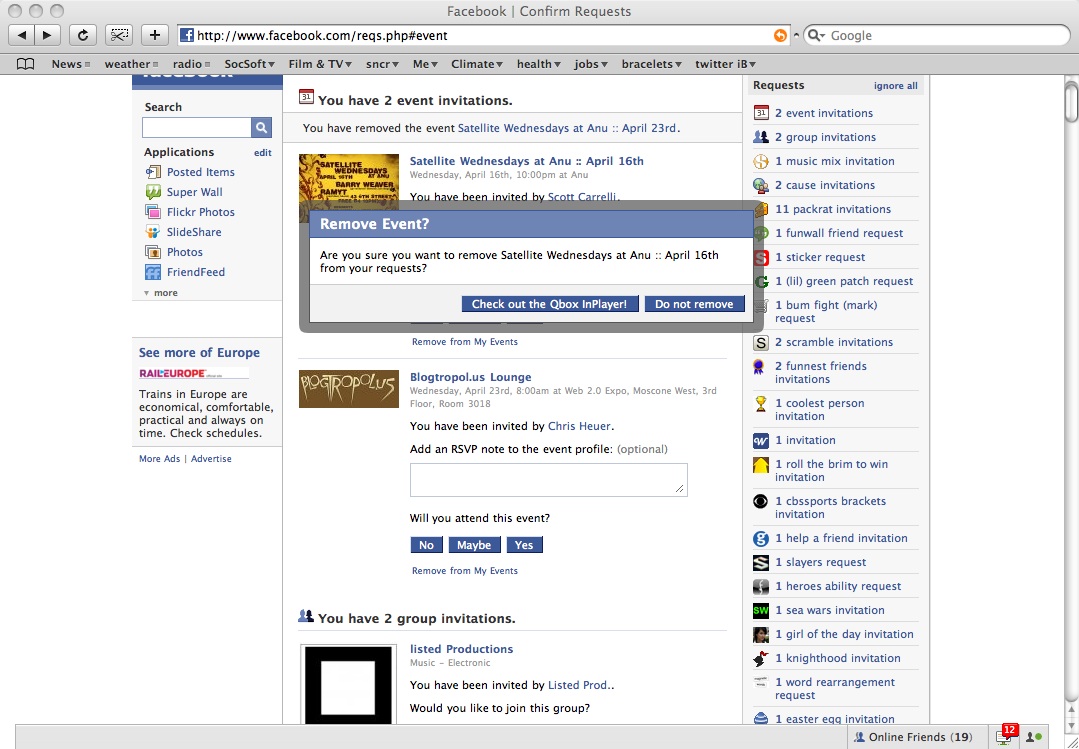
[Resist] [Submit} ... advertising in facebook dialog boxes?


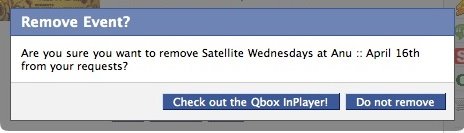
Here's a bug worth noting, if only for the fun of it. I've always wanted to see a dialog box pick up the cause of users everywhere by offering a choice of "submit" or "resist." Utterly useless of course. Perhaps an idea for a t-shirt.

Well this one must be a bug, because the I had just removed the exact same event successfully with options of "remove" or "do not remove." If this is social media marketing, it earns points for creativity. Whether it would count as user choice, however... Maybe if I opt not to remove and then try again I'll get a different ad in place of the "remove" button? Or is this the only sponsor the event organizer has lined up? If so, and the option is to go to the event or check out the Qbox player, I should take the latter. But will it show up in my activity feed? And if it did would my feed state that I'm going to the event and checking out the Qbox player?

Will users submit to advertising of this form? Methinks they'd rather resist!

Labels: , , ,

Thursday, January 03, 2008

Scoble banished for botting Facebook

Folks who know me know that one of my interests last year was social analytics -- and that I'm interested in new ways of capturing and representing our online profiles and activities. Well the news that Robert Scoble's been kicked off Facebook for running scripts indicates, for now at least, that we're going to have to wait on the social networking sites to give us data after all. There's nothing unexpected in this, and I would be surprised if Scoble was caught by surprise.

http://scobleizer.com/2008/01/03/ive-been-kicked-off-of-facebook/

Labels: , , ,

Tuesday, August 21, 2007

Twitter vs Facebook status feeds


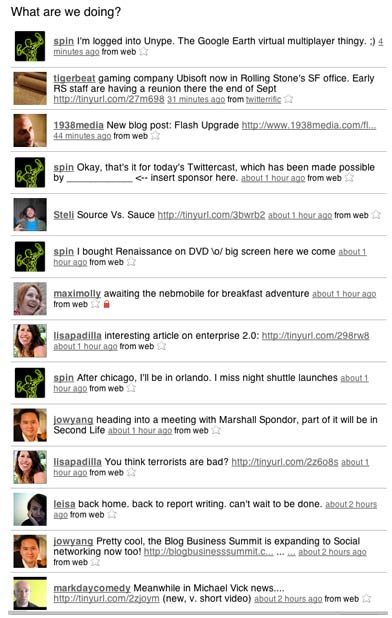
Twitter was conceived as a status updater copasetic with sms. Ironically though, it's become a personal broadcast service, while facebook's status updates read like true updates.

We write to an audience, in this case twitter followers or facebook friends. Here facebook has the advantage in that we can take our audience for granted, whereas on twitter our sense of the audience generally diffuse.

Twitter does produce those brief conversational runs -- an effect of the tool's strange manner of creating presence.

Twitter posts are more likely to be conversation starters. and are more talkative. They often invite acknowledgment if not response.

Facebook status updates tend to be tales and statements, told in a non-conversational tone and for the purpose of getting on the radar.

Twitter can be more addictive for the reason that we might itch to check it -- for replies or news. It's more psychological.

Facebook's feed is more of a social utility, and it seems less psychological (there are pokes, walls, and apps for that).

I'm back to blogging. Took a break in order to focus on a couple new social interaction design white papers and to work on some company ideas.

Labels: , , ,

Wednesday, October 04, 2006

You looking at me? Invisibility at Facebook


According to Techcrunch last week, Facebook has enabled the following updates to privacy controls, hand in hand with its grand opening (to the public; facebook was an invite only community):


  • Block other users in specific networks from searching for his or her name.

  • Prevent people in those networks from messaging, poking and adding him or her as a friend.

  • Control whether his or her profile picture shows up in search results.


I don't have anything against Facebook. I'm a triber myself, but that owes more to being in San Francisco and discovering social networking years ago. Tribe today is a hidden gem, a hole in the wall in the bustling downtown of myface.

One can't help but see the remnants of cliquish antagonisms, though, in the new privacy controls listed above. It seems Facebook members are actually searched out by name (but only by members of a network (read: school/group)). Glad I didn't do anything terribly cruel to anyone in school. Glad I tied up all those aborted flings and unfinished relationships. Glad I'm old enough that my picture is probably not recognizable to anybody I knew intimately back then! And phew, I knew who my friends were -- because I wouldn't have anybody citing my friendship unless it was the real thing!

Privacy controls have a double function on social networking sites.

  • they allow users to describe their relations, especially friendships, with others

  • they allow users to manage their "presence availability" online, meaning that they allow users some control over access others have to them, be it simply referring to a user, seeing his/her picture in search results (to wit, new facebook features), or be it communication settings like IM, skype availability, commenting, emailing, etc.


One can't help but view Facebook's update as an attempt to head off attempts by new members to mine facebook for old connections, friendships, relationships, enmities... It's as if an online social network were gearing up to meet actual social networks: present, meet the past.


Technorati tags: ,
,

,
,
,
,
,
,
,
,
,
,

Labels: , , , , , , , , ,