Thursday, March 25, 2010

Rethinking thin: social relationships in social media

In a recent post titled The Social Media Bubble, Umair Haque raises some provocative questions concerning the value of the relationships we form on the internet. His post has drawn some attention, and I'd like to quickly throw in my two cents.

Haque wites:

"I'd like to advance a hypothesis: Despite all the excitement surrounding social media, the Internet isn't connecting us as much as we think it is. It's largely home to weak, artificial connections, what I call thin relationships."

Now I don't have a quarrel so much with some of his conclusions. I have an argument with how the issue is framed.

I don't believe that we should be thinking in terms of relationships. Rather, I believe the issue should be framed in terms of communication. My reasons are fairly straightforward. If we focus on relationships, we attribute to the relationship what actually belongs to communication. We call them thick or thin, we describe them as strong or weak ties, and we measure the value of connectivity in terms of network density and connectedness. We place emphasis on the tie, rather than on the subjects (people) knitted together.

My issue with this is twofold. First, I think it's a mistaken transposition of the logic and analytic of social network analysis to the attributes and qualities of human relationships and social organization that social network analysis doesn't really address. In social network analysis, the tie is privileged over the node, that is, the connection over the subject (person). But all ties are not equal. And ties are not really relationships.

I cannot imagine a psychologist inquiring as to a client's network density, Dunbar number management issues, or presentation of negative Facebook connectedness symptoms. Ties, used in social network analysis, are a means to abstract and diagram the connectedness of a number of nodes/individuals deemed to be connected. It's got nothing to do with the experience of relationships, the depth of human commitments, feelings of isolation or involvement, not to mention the substantial domain of emotional and communicative wealth that is transacted daily in the form of civil social conduct.

If we are interested in the meaning of social networking at the human scale of experience, then ties are the wrong way to think of it. The social network analysis model of social is an abstraction. It neither lays claim to causal explanation of interpersonal communication and meaning, nor to a properly humanistic observation of the emotional and lived life of members of a society. What it can do is abstract the number, density, and connectedness of members of a bounded network. And in that, surface patterns. But to mistake the tie for an intersubjective relationship, or to subordinate the tie to the mode of its reproduction -- which is communication -- is a mistake.

And this is where we trip ourselves up. For when we talk about social relationships and the social web, we inevitably turn to our own experiences. We rally in defense of the thin tie, the weak tie, follower numbers, connectedness, and what have you, in arguments based on personal experience. But of course! Social networks, and social tools of talk, as I prefer to call them, are quite simply a new means of mediating communication and interaction in a manner that captures and preserves interactions on a publicly accessible medium. Ties are not the explanation, communication is.

My second issue with the misuse of ties-as-relationships has to do with relationships in general. They don't exist. We relate to each other, and in our communication and interaction, express and "exchange" the content of communication and the meta-contents of emotional and affective interests. We are relational; society is relational. But never and in no social theory that I know of are relations reducible to this notion of a tie such that subjective human experiences can be described adequately by the tie. There is no tie -- there are two or more subjects committed for a stretch of time to pay attention to one another, take interest in each others' interests, handle the interaction in an acceptable fashion, and to some degree commit to communicate again. If, in social networking, we exchange tweets with one another for just a moment, but never again, then we have had a passing interaction. It's that simple. Ties and relationships don't have to be brought into the equation.

The medium facilitates asynchronous communication between people whose mutual connectedness online can make them present to one another in a fashion that transcends the limitations of physical co-presence. And which, for its capture and storage of that communication in the form of a digital textual artifact, renders this communication in a way that, within the medium only, lends it some persistence and durability. All of which leaves behind content for later use, re-use, recontextualization, and what have you. That's what it's good at: mediated communication and interaction.

While I suspect that our tendency to use social networking metaphors as descriptions of "the social" owes to the fact that we as much technologists as we are sociologists, the whole matter of social relationships has been a matter of some cultural concern for a while now. It's perhaps a post post-modern thing. Or a technology and disconnection thing. We have seen it in pop culture for years. Movies like Crash, Babel, Amelie, and countless others take up social relations and society -- as characters are brought together over seemingly arbitrary and random events and connections. In TV shows like The Wire and LOST the theme is explored in terms of the multi-layered interdependence of different social classes and institutions, or in the formation of communities out of nothing but a random event. And these shows are direct descendants of earlier works by Altman, Godard, Fellini, even Fritz Lang (M) and so many others.

The organization of the social is a perennial interest. We want to know what relates us and how we relate. We want to know what a commitment is, what trust means, and how loyalties and friendships are created, sustained, and preserved. Technologies of communication are a means -- in this day and age of communication, they are a means of production. A means and mode of the production of communication. And for this reason, a contributing factor in the organization of the social. But they are not a metaphor for the social, are not an abstraction of society's connected architecture, or an explanation of social byproducts and human experiences such as friendship, intimacy, groups, or communities.

Relationships are maintained by communication. Interactions frame the possibilities for communication between subjects whose attention is focused on the shared experience of a social situation. Social tools change the nature and modality of both interaction and communication, simply because they permit both to occur disembedded for time and place. It's not the tie that is the relationship, it's mediated social action by means of which communication is used to relate. And as we all know, and have experienced, the meaning of relating to one another online comes in all forms and shades of significance. Furthermore, relations may be unilateral and one directional, bidirectional, or triangulating and mediating. They have affect and real human interests: we like each other, admire each other, pay attention to, support, encourage, quote, refer, include, remember, and forget each other. These are our experiences and in our experiences are how we relate.

The tie has no such attributes, and in social network analysis, may not even capture directionality. Ties are not mutually affirmed or reciprocated. Communication and interaction is. What's more, the tie may falsely sustain the appearance of a bind that exists. But as we live our friendships and communities, and use our social tools as means of communicating, we pass in and out of attention as well as through different periods of interest and engagement. Much of this is even just social observation; where is the tie and how would it be captured when the act of being involved is an informal and somewhat haphazard habit of following twitter. The experience of social observation is hardly counted in social networking, for the simple reason that our tools can only capture actions.

It is easy to undersell the value of social tools on the basis of relationships. But to conflate relationships with the processes and practices of communication and interaction is a mistake, and places the cart before the horse. Relationships form out of communication and are sustained and reproduced during stretches of interaction -- stretches that include periods of passive engagement and un-involved social presence. That these aspects of subjective experience cannot be captured and represented in the form of a tie is just the misapprehension of human relationships in the form of abstract models of connectedness. Social life is transactional.

Related:
Social Media in Isolation is Useless to Government, to Business, and to You Mark Drapeau

Umair Haque Is Another New Spatialist Stowe Boyd

Labels: , ,

Monday, September 29, 2008

Swurl: lifestreaming and timelining


Like many of you, I simply can't keep up with the river of lifestreaming applications hitting public beta this year. Many seem to simply do the same thing, more or less, with a bit more of this or a bit more of that to differentiate each from its competitors. But social apps are bound, perhaps more even than "conventional" software, to conform to best practices. Why? Because they are social applications. Social applications succeed only if they can extend the individual user experience out into new and interesting social experiences.

And they do have to be interesting -- for social applications, again more than conventional software, must be interesting. More often than not they are interesting because they are used as tools for talk. Talking with, to, at, amongst, in front of, behind, and to the side of. Talking with friends tends to be interesting to those involved simply because it is among friends. But where the face to face dimensions of social interaction are also rewarding for the obvious reasons, social applications must deliver a working substitute. There is no real "spending time together" online.

Even chatrooms, which are as much a precursor of lifestreaming as anything else online, can only approximate this sense of togetherness. I recall early days in IRC chatrooms where that sense of being there or of being in it was as much due to the suspense and waiting (for somebody to type out their response) as it was due to the "room" itself. One might even argue that this pressure of time grows in the user the slower the technology is to record and transmit time. The longer the latency, the greater the waiting, and thus the greater the anticipation, suspense, and urgency! (Is it not said that suspense in film is simply the time that it takes for something to happen?).

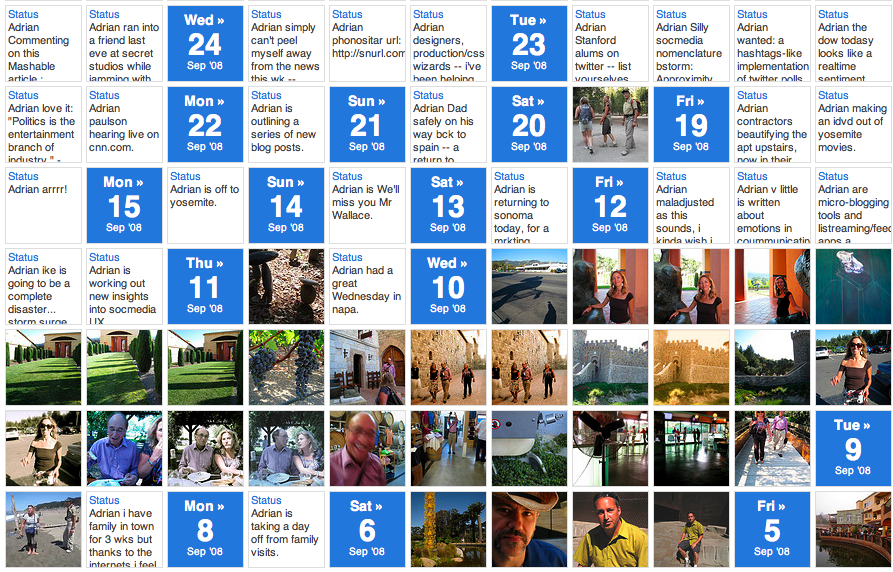
Swurl.com is interesting because it has a visual timeline of the lifestream (pictured above). In calendar format, and well-designed, the timeline looks good and is an attractive visual representation. It's low on conversational content and talk, but it captures the past of a user's activity in a compelling presentation. Plurk.com also has a timeline, but one that is used to steer interaction (and which looks more like a horizontal river display). Not only does Swurl's calendar provide thumbnails of pictures and shortcuts to posts, it expands to accommodate periods of heavy activity. All days do not look alike. I like that.

This variation is important in lifestreaming apps. In contrast to the profile-based site or service, the stream stands in for the profile. The person's talk stands in for profile elements. These choices make sense, because the call to action in a lifestreaming service is talk. It's not browsing, searching, or navigating. At least not quite yet (I believe we're ready for more order and structure). Really, each message/post/tweet in a lifestreaming app is its own call to (inter)action, which is also why most users are in it "now" or never.

Which makes Swurl's representation of past user activity interesting to me. Most lifestreaming have stayed away from the archive of past activity (what's the pleasure in paging backwards through a user's posts?). But there's a lot of value in past activity, and visual coverage of the past can take many forms (think Edward Tufte). We've seen none of them yet (Chirpscreen's slideshows come to mind, though it would be nice to see them become actionable) but I'm certain that we will.

If twitter is the power curve of lifestreaming, then apps like swurl might show us some of the value in the long tail -- the long tail being the past. To picture this, take the standard long tail graph and turn it sideways. The Present is the curve, the Past is the tail.

Mining the tail of time is mining in depth rather than mining across connections. Mining the connections of past time, for lifestreaming apps, might mean drawing connections across the past times (pastimes, experiences, too) of a site's users. Currently, Swurl engages conversations around a user and his or her posts. But we could imagine indexing user streams for the purpose of making connections and extracting content. After all, a user's post posts, talk, uploads, etc are used by many applications to predict or anticipate choices and preferences.

I'm excited to see what Swurl, with minimal complexity, has done to wrap a bit more around lifestreaming than we get out of tools like twitter. Twitter will remain for me my primary talk tool, as it has and will continue to have the best audience awareness. But if you wanted to imagine social networking, and profile-based social networking around lifestreaming instead of profile pages, Swurl would be a good place to start.

Join me on Swurl!


Related reading:
Readwriteweb on Swurl
Techcrunch on Swurl

Labels: , , , , , , ,

Wednesday, February 27, 2008

Directions for research, theory, and a general update

I've been off blogging it seems for quite a while, and while I feel out of the loop in some respects as a result, it's been healthy and productive for a number of reasons. That said, I'm going to try to resume short post blogging as a means of thinking out loud, and sharing my plans for research and conceptual work in the year ahead.

When I took time off blogging I got caught up in Twittering and Facebooking instead. I like to immerse myself in new applications to get to know them from the inside, and last summer and fall I managed to build a new conceptual, and much more psychological system of analysis, by means of using tools and observing my own and others' use at the same time. I have to admit that for weeks at a time I lost myself in a variety of user and personality positions, and managed to go deep into a number of different use cases, modalities, "personas" or personalities, user motives and intentions. I couldn't do that and blog at the same time, for to adopt and play out a user position while reporting it publicly just wasn't possible. I took scores of pages of notes and over December and January wrote up what is now another social interaction design tome, this one on the psychology of the user experience in social media.

While also doing client work for several startups and social media companies, I've been researching the industry and state of theory, user psychology, media theory, and social network analysis and metrics, for the past month. It's now time to integrate my own theory development with current practices — a project that will probably take me through spring.

I made a decision, after becoming senior fellow at SNCR, to also focus some on purposeful social media — networks and communities, and social media marketing, for social good and global change. My own social media fatigue has left me hankering for evidence and best practices of social media used to promote real and offline transformations. The "pure forms" of social networking (profile-based friend and socializing sites) have run their course for me, I think. That said, I've noticed an increase in calls to participate in professional community designs and thematic social networking in non consumer-oriented markets — a sign that even if consulting opportunities in viral verticals drops off, interest in the utility of social networking among communities of practice is growing.

MySpace and Facebook continue to spark compelling opportunities in markets and among brands/companies that see the potential in cementing latent communities. So even if time has run short for companies seeking success in social netorking for movies, music, pets, and so on and so forth, there seems to be a growing sense that more structured and thematically-contained sites have a future worth exploring. Even if facebookers are rapidly uninstalling social apps, and users are consolidating their network memberships down to the few that offer real social utility.

A few points then, for those interested in what I've been up to during these last quiet few months, on the areas I've been digging into:

  • A set of psychological profiles and definitions of user types loosely based on self psychology, communication styles, and pathologies that defines up to 15 user types by their interaction and communication competencies and inclinations. Roughly and simply, these user types contrast with those more commonly used to characterize influence and brand advocates, or mavens/connectors (models we see referred to frequently). I've instead sought to design a set of personalities around the user's encounter with the medium and his/her self presentation, communication, and interaction styles. It's a complicated model but is based on: the user's sense of self and sense of the other (audience); the user's interest in the medium itself; and the user's tendencies and communication styles as they pertain to interacting with others online. I see the user as having a self image; a sense of how s/he appears to others; a tendency to become involved in a social application and activity (call these their interests in being online); and a personality-based cluster of habits and tendencies to read, interpret, and become engaged through mediated communication that correspond to the individual's characteristic handling of ambiguities of intent, motive, sincerity, truth, and so on. I know, it seems complicated, but my model is tailored to online communication; most others are not. I view the screen as alternately a mirror, a surface, or a lens/window. This has helped me develop models for interaction that ground user engagement either in themselves, and self image, or in the content/interaction published to the screen, or in communication with the other. I'll wrap this up by spring and post as a white paper. This one should round out my social interaction design work (previous papers addressed culture/community and epiphenomena of social practices; and the architecture of screen and interaction design and its role in organizing and structuring of social interactions and communication).
  • Social media marketing and the potential for commercial messaging in everyday social media practices. Clearly we're only at the beginning of what could emerge as a burgeoning industry, and possibly the next phase of web marketing. Not banners (phase 1), not contextual ads (phase 2), and not search engine advertising (phase 3), but activity, news, and friend feed product placement and social practice-embedded advertising and marketing. I was preparing a presentation on the challenges of feed-based advertising when Beacon up and flopped, and have tabled this work for the time being. Though I personally believe that social (graph) marketing, not one-to-one relationship marketing, is the Holy Grail for commercial market, product, brand, and event promotions of the future. This is a tasty field for its linguistic, trust, and relationship issues alone, not to mention the more and currently conventional issues of social graph analysis, "influence" analysis, semantic, and sentiment analysis. 
  • In close relation to my research into social media marketing, I've mapped out a blueprint for social media analytics that accounts not only for relational attributes (the social graph), but also content (which is notoriously difficult) and intention (also difficult) and which is based on an understanding of the user engagement as measured by onscreen actions, longitudinally tracked, and matched to the psychological profiles I mentioned above (since all button clicks are not equal). I'm fascinated by the possibilities for social media analytics, and while user agency is extremely difficult to interpret online, especially because we can only capture "positive" actions and have no purchase on "negative" choices (there's no tracking of "not clicking"), an analytics is necessary if social media marketing is to achieve accuracy in reporting and campaign management. This work, too, is tabled at the moment.
  • I've been hunting down all the research I can possibly find on the impact of social media on mass media, and on the value of social media in topical conversation and cultural discourses of climate change. I think I wanted to know if social media can help save the world. This research is extremely difficult to conduct. There's no semantic tool out there that can scrape and measure the topical content and map the discursive practices on, say, Facebook or Myspace. After browsing and using a number of social change/green marketing and environmentally-oriented social action, activism, and discussion communities, I've not been able to figure out how to conduct rigorous research or analysis of either their impact in motivating other users, changing behaviors, or augmenting news and coverage of climate and green topics and themes. There's simply too much noise in social posts (posts to communities that get attention, or are biographical, or are too short, or are simply spam/junk). There is anecdotal evidence that mass media is informed by and assimilates the blogosphere, citizen journalism, youtube, and other social media contents — but it's anecdotal. Were one to attempt to show that social media can help change the world, I'm afraid it simply couldn't be done. Too much user participation has the intention of producing presence and self identity, of attracting friends, or of distributing user presence across groups and communities that it's simply not possible for us to know that a user means what s/he says, or says what s/he means (feels, cares about). And as participation rates increase on social networking sites, so too does noise and the meta-communicative byproducts that result from user behaviors and participation that seek attention, popularity, like-ability, and so on. That said, and not to toss a wet blanket on what clearly concerns an awful lot of people, stuff is happening, and the social web is clearly a player in producing discourse, reflection, critique, coordination, as well as green branding and marketing. I just can't see how to measure it.
  • Lastly, I'm continue to take and keep notes on social applications, widgets, and all manner of social interaction and communication systems useful for the direct and intended purpose of a specific user experience, or indirectly for the production of practices and pastimes. A social interaction designer needs to know what works — whether it was meant for what it does or not! I still believe that social software is functional when as software it is dysfunctional. And for this, as a software development practice, social networking tools and applications are still an interesting domain. But man, are there a lot of silly apps on facebook... Somebody else is going to have to use them all! 
Well, that's my update. I'm working on what research I can conduct, hoping that it will validate my psychological profiles and cement my blueprint for social analytics at the same time. I may have to give up, for the time being, the idea that a "MyChange" can save the world. And instead focus on the use of niche networks to realize community potential and produce practitioner knowledge and relationships. That's what a gigger does to get the gigs. 

But if you have an opportunity, and the resources, with which to do something really big, don't hesitate to call!

Labels: , , , ,

Thursday, January 11, 2007

New Social Software Design White Paper

White Paper: Social Interaction Design Guide: Social Media, Social Practices, Social Content 76 pages. by Adrian Chan


I've had to take a break from social media blogging lately to work on a few white papers and reading notes. There's only so much you can do in a short form blog post!

In this recent white paper I take the idea of socio-technical competence seriously. Social theorists wouldn't conventionally associate technical competencies with matters of social interaction, communication, and so on. Technologies are supposed to be props, objects, things; and as such, not essential to social encounters.

But when the communication runs through a technology, when it's a matter of user-device-user interaction, then the medium's role comes into play in a big way. So this white paper takes a look at how social media and social software sites are designed. I assume that users and visitors are able to tell when the contents of a page reflect social interaction. We might even argue that it's this kind of competence with online media that has made Web 2.0 possible. (If you believe that the social and cultural conditions need to be prepared, or grown, before people can see the value in new technologies, and realize them). I assume that users understand that the etiquette on a dating site is different from the etiquette on a career networking site. I assume that youths are clear about the self-reflective use of testimonials published on their friends' pages (what they write says something about them). And so on, with further assumptions.

Social interaction design suggests that the architecture, functioning and features, the use of screen real estate, the particular presence of people (faces, profiles), or general suggestion of audience presence (as on amazon, imdb), the organization of content by tags, that all these design decisions are social, not technical in nature. If you have built a television and nobody's watching, you don't fix it by adding buttons to the remote control. It's the same with the design of social media. We're now very clearly in a paradigm shift that is likely to reverse the roles, disrupt the talent pools, redraw the territories, and fundamentally change the mode of consumption and attention given to social and mass media. This shift affects software and technology design and content production and programming (network TV, cable, movies, radio, etc.) equally.

When media are social, the need for high production value diminishes because other people grab the user/viewer's attention instead. The possibility that anything posted online might solicit a response transforms content from its form as an object to its potential use in a round of communication or talk. I still believe that all social media are talk systems, including Youtube (in which the "utterance" begins with a video and the response can be video or commentary). And therefore social software designers have to attend as much to the enabling of talk and interaction, on the page and over time, as they to do the elements of traditional web development.

Check out the white paper if any of this is interesting. It runs over much of my theoretical framework and then dives headlong into the organization of content into modules and lists, top tens, most viewed members, and all of the other means of social content organization.

My next white paper, coming this month I hope, will feature new uses of links and relationships at the social as well as object or data level. My sense is that the link is no longer a document link but a view, a node if you will, and that the web 2.0 organization of social content and participation will increasingly permit users to pull together people or pages depending on their preferences, affinities, interests, and so on. And that those, stored within and across social media networks, will create vast opportunities for commercial systems to learn about the associations that make sense and which layer onto objects and data a social and personal appeal. At which point social marketing and relationship marketing ought to really take off, and social interaction design with it.

Social Interaction Design guides and White Papers
Social Software theory Reading Notes


, , , , , , , , , , , ,

Labels: , , , ,

Sunday, October 15, 2006

Webocracy, Mass media, mini media, MySpace, YouTube

An article in today's SF Gate caught my eye. It's title included the word "Webocracy," so I knew right away that it must have to do with web 2.0, Silicon Valley, and the like. Like the term "folksonomy," "webocracy" captures the new in something old. In this case, democracy done online, retooled and perhaps even improved. Folksonomy, similarly, refers to a kind of social economy that bypasses traditional markets but which uses online markets and economies instead. I'm no fan of analogies used as explanations, especially when the new thing isn't well understood yet. Analogies refer us to something familiar -- in this case democracy and the web -- but the claim that this thing is like that thing has a communicative function but little more.

Let's unpack this one real quick then. Webocracy. Is the internet, and more specifically, the world of web 2.0, a new kind of democracy? It is grassrootsy, it does invite direct participation, it does threaten traditional modes of political engagement (e.g. bypass the lobby(ists), go straight to the back, where the power is...) but it's not a political system. The web is a communication and publishing technology, one that now delivers audio, video, and other modes of information and communication. But it's not just a technology. It's becoming an integral part of all manner of social phenomena (to wit, YouTube as the new TV, MySpace as the new marketing media). Technology plus culture give us new social practices.

It's the new techniques (technology = technique or application of a rationalized method) for communication that fascinate me, and the ones that seem to affect us at the core most of all. I don't think web 2.0 companies or phenomena represent a new political system, as might be suggested by the term webocracy. The same could be said for the term folksonomy. But there's a change of mode, of connection, of the relationship between individual and information, individual and individual, and individual and mainstream media taking place whose engine is web 2.0.

I call them talk systems. And where they get interesting is when they offer a marketplace, and they create an economy. I think those are the phenomena catching our attention these days: online markets in which economies based on recommendations and social networking create a different kind of consumption, one that is moved by communication between consumers instead of messaging and marketing by mainstream media. I call mySpace mini media, in opposition to mass media: it's got all the stuff off a medium, but its content is its own culture (a culture which often refers to mass media messages, images, events, celebs, etc.).

If you figure that a market simply makes goods and services available, and connections between buyers and sellers possible, but that an economy involves the people, their consumption habits, desires, choices, motives, etc, then clearly an online marketplace isn't enough to get anything going. It'll need users, and those users will need to know how the market works. It needs to exist, to find expression in common culture (it needs to be seen and talked about). So in addition to a market that connects goods, buyers and sellers, and an economy to organize the people and their economic consumption (note that an online dating service has a market, and an economy), the system has to be seen, has to exist. Here's where "mini media," or online phenomena like YouTube and MySpace, veer off from the phenomenon of mass media to launch something new: they exist through the communication of their members.

So where traditional mass media use magazines, newspapers (e.g. print media), radio, and television, all of which broadcast their messages, these new web -based media reproduce themselves through communication among members. Like other media, they exist by observing themselves, but these observations are given us not by pundits, djs, hosts, anchors, journalists... Observations of the medium are produced as ratings, votes, tags, bookmarks, blog posts, comments, etc. A very simple flow gets going (it's been called viral but it's got nothing to do with viruses. viruses are duplicated perfectly when transmitted. communication doesn't work that way, it has to be compelling if it is to circulate). That flow is an economy, one that picks up signs, assigns value, has speeds and crowds...

Talk, talk, talk, is the observation mode of web media. User participation. Social interaction. Instant messaging, posts, comments, email to friends, forward, bookmark, tag and rate, vote, vote, vote. What does all that do? It assigns value, assigns value. It's a different medium: a mini medium in comparison to the mass media (if you think money), a medium that for the most part serves as commentary on and observation of the mass media (hence its value to marketers), and which is "susceptible" to its own delusions, rumors, gossip, trends, and wipeouts. YouTube and MySpace are not produced by corporations, they don't occur over those media (radio, print, tv). It's no accident that these phenomena have remained where they are: online. That's where they can lay claim to a new social practice: the talk system. And perhaps the talk marketplace, the talk economy. (The term is social media, social software, but the social is talk).


Technorati tags: , , , , , , , , , , , , , , , , , , , , , ,


(cross posted in my culture blog also)
related:
Myspace as mini media

Labels: , , , , , , , , , , , ,

Friday, October 13, 2006

YouTube: videos are signs, watching is social

Marshall McLuhan, in Understanding Media, writes:

"What we are considering here, however, are the psychic and social consequences of the designs or patterns as they amplify or accelerate existing processes. For the 'message' of any medium or technology is the change of scale or pace or pattern that it introduces into human affairs."

To say that YouTube is not just video hosting or video watching is stating the obvious. The social participation YouTube gets in the video posting, commenting, rating, and circulating is what made it the killer app of hosted video. It is precisely YouTube's popularity that set it apart, and earned it the ability command a huge acquisition fee (read: head count. It was the audience head count, which to Google looked impressively like loyalty, and they may be right, which is why they'll leave it as YouTube for a while and keep their little "video NEW!" link sandwiched between images and news)...

I asked in a recent post what the content of YouTube is, using McLuhan's formula that a medium's content is a previous medium: "This fact, characteristic of all media, means that the 'content' of any medium is always another medium. The content of writing is speech, just as the written word is the content of print, and print is the content of the telegraph.” Then if the content of YouTube is television, its value was measured in terms of audience share (not advertising or programming quality). YouTube was clearly the biggest of the online video networks.

If the content of YouTube was television, but modified because it is online, then its formal content was television, its content as substance is viewers (users). And why is this so important? Because it would be a mistake to see YouTube in terms of its core value proposition: watching video. YouTube is a communication medium, and its real value lies in providing a marketplace "in" which people gather to pass around videos they like. "Watch this, you'll like it" is conversation. It's a statement, and YouTube is full of them. Look up Robin Williams and the first page of results are all the same 2 min and 19 second clip of Mr Williams doing a Scotsman inventing Golf. Why? Because posting is, as we learned from blogging, the fundamental act of communicating. Not reading. Not watching. (Not listening!)

This will all get more interesting as we look at the nature of utterances and communication involving video as reference. We need to compare YouTube and related phenomena to the blogosphere and to blogging. Ask yourself, what is it to refer to a cultural commodity or object, in a statement addressed to friends (or anonymously, to the world). What is that act? Is it a "look at this" act or is it a "look at me" act?

Or is it a "look at me looking at this" act? Let's suppose that the videos on YouTube are like commodities, and that they have the sign value that we associate with fast cars, exclusive brands, and other status symbols. I'm not suggesting of course that some YouTube videos better brands than others — videos aren't brands. I'm suggesting that videos signify social relations.

Videos on YouTube, because they are on YouTube, accrue social significance. That a person wants to share a video with somebody, be it by telling a friend or by posting, or by commenting, means that person likes it. And wants to communicate that like. In a "public" setting, identifying with a commodity carries social connotations. I'm into guitar rock. Or stand up. Check out these Bush out-takes. etc. Each video, in addition to its own content, has a reflective signification also: to like something is a reflection of my likes. The particular (video) makes a general reference (this is my taste). That's the social move. Association with videos can now become social, using the commodity form, as other commodities are social (the status symbols mentioned above). And they're free! Fast! And the consumption of them is ephemeral, and it doesn't oblige anyone to post one back, or to applaud, even to publicly agree.

The social works in online marketplaces like this by establishing a communicable interest between a user and his or her selections (books, videos, music, blogs, etc). If the interest were personal only, it wouldn't need to be communicable. It could just make sense to the person and end there. Its communicability is a sign that it's social. But in each medium, in each application (social software site, community, marketplace, etc) the site has to successfully create an audience/public, and successfully enable the linking of user to interests, and communication of these selections to individuals, groups, and the audience at large. One cannot really wait for the other. Hence the importance of viral marketing, and hence the advantage that has returned to first movers.

Our next investigation ought to be into the changing nature of sign value, of commodities as form and of our relations to each other through these mediators.


Technorati tags:
,
,
,
,
,
,
,
,
,
,
,
,
,
,
,
,
,

Labels: , , , , , , , , , , , , , , ,

Monday, October 09, 2006

Marshall McLuhan on YouTube

There's a great scene in Woody Allen's Annie Hall in which Allen, overhearing a guy in line for a movie refer to Marshall McLuhan, produces McLuhan with the words "as a matter of fact, I have Marshall McLuhan right here." It's a hilarious bit of comedy. I can't produce McLuhan, but I did find him on YouTube.com. I looked for him on YouTube because I wanted to quote McLuhan's theory that every medium has a prior medium as its content. I've been thinking about which medium YouTube has as its prior content (more on this soon). To find McLuhan as content on YouTube, is, well, a bit Annie Hall... (sorry, it's not the *real* McLuhan but only a trailer for a History channel special... the comparison deepens... is the internet a parallel medium to tv? Is an actor playing mcluhan in a video on youtube about a television program about a man who said the content of television is theater a simulation of the real thing quoted in a communication medium or a message circulated in the mass media sampled by a consumer and posted to the mini media or a marketing ploy by the mass media or is it simply the content of my post? things get strange in the mediated world...)

So, which medium is the content of YouTube?

"The electric light is pure information. It is a medium without a message, as it were, unless it is used to spell out some verbal ad or name. This fact, characteristic of all media, means that the 'content' of any medium is always another medium. The content of writing is speech, just as the written word is the content of print, and print is the content of the telegraph." Understanding Media, p 8.


Technorati tags: ,
,
,
,
,
,
,
,
,
,
,
,
,
,

,
,

Labels: , , , , , , , , , , , , , , ,

Wednesday, October 04, 2006

You looking at me? Invisibility at Facebook


According to Techcrunch last week, Facebook has enabled the following updates to privacy controls, hand in hand with its grand opening (to the public; facebook was an invite only community):


  • Block other users in specific networks from searching for his or her name.

  • Prevent people in those networks from messaging, poking and adding him or her as a friend.

  • Control whether his or her profile picture shows up in search results.


I don't have anything against Facebook. I'm a triber myself, but that owes more to being in San Francisco and discovering social networking years ago. Tribe today is a hidden gem, a hole in the wall in the bustling downtown of myface.

One can't help but see the remnants of cliquish antagonisms, though, in the new privacy controls listed above. It seems Facebook members are actually searched out by name (but only by members of a network (read: school/group)). Glad I didn't do anything terribly cruel to anyone in school. Glad I tied up all those aborted flings and unfinished relationships. Glad I'm old enough that my picture is probably not recognizable to anybody I knew intimately back then! And phew, I knew who my friends were -- because I wouldn't have anybody citing my friendship unless it was the real thing!

Privacy controls have a double function on social networking sites.

  • they allow users to describe their relations, especially friendships, with others

  • they allow users to manage their "presence availability" online, meaning that they allow users some control over access others have to them, be it simply referring to a user, seeing his/her picture in search results (to wit, new facebook features), or be it communication settings like IM, skype availability, commenting, emailing, etc.


One can't help but view Facebook's update as an attempt to head off attempts by new members to mine facebook for old connections, friendships, relationships, enmities... It's as if an online social network were gearing up to meet actual social networks: present, meet the past.


Technorati tags: ,
,

,
,
,
,
,
,
,
,
,
,

Labels: , , , , , , , , ,

Wednesday, August 16, 2006

Folksonomic Value Proposition part 2 Revised

"First hoary axiom: Value comes from scarcity. Take the icons of wealth in the industrial age&emdash;diamonds, gold, oil, and college degrees. These were deemed precious because they were scarce." Kevin Kelly


It's The Folksomy, Stupid
Folksonomies add value in economies governed by surplus, not scarcity. Folksonomic value narrows down what is otherwise overwhelming and indistinguishable. It's value supplied in the form of recommendations, relevance, and knowledge and expertise.

In an earlier post on folksonomies I wrote the following: "I'm tempted to say that social media uniquely captures participation: a means of production that records its own consumption. And whose consumption is its distribution. Only electronic media can claim this, for it's only with digital media that consumption does nothing to the original, each product being a copy already."

The goal of folksonomies is the non-hierarchical and unbiased production of knowledge (value). This is no small thing and as an editoral pursuit it would have nobility and loft. As a goal for organizing participation, communicating to the public, and structuring social participation in a mass medium, well, it's downright revolutionary. Put it to social software types to think small!

Be it in urls or their categories, folksonomies (known also as tagging, and tag cultures) aggregate the efforts of many into a system of pointers that, in theory at least, represents a filtered stock of knowledge. Involvement of active readers in the organization of online content creates a vast "knowledge base" that offers an alternative to search engines (power in the hands of one: google), online directories (too unwieldy, who drills down any more?), and editorial sites (who do you trust?). What's more, tagging produces results that are more human than a search engine's and less hierarchical than a directory's. The process is participatory and open, which means (or ought to mean) that the results are dynamic, living, and democratic.

But the medium itself, that being the Web, plays a role in the production of folksonomies, as any medium plays a part in production of the content that comes out of it. There are far too many web sites out there, far too many blogs, news stories, etc., for any population to evaluate and organize without technical assistance. Information is not scarce&emdash;knowledge is scarce. Knowledge is the distillation of information into meaningful statements, judgments, valued insights and prescriptions. It's always less than the gross stock of information, and producing it is a matter of time. And time, as they say, is short.

The Age of Communication Needs Your Attention
If the key resource during the industrial age was power (labor and natural), it was information during the information age. And I'd venture to say that in our current communication age, it's attention that's scarce. Attention, as in getting information in front of a person and claiming some measure of their consciousness (mind share). Time-based mass media are meant to create and focus attention over a strip of time (e.g. half hour TV shows); participatory media like the web (which came out of print) also deal in attention. But the fact of digital duplication only compounds the state of excess and overload that characterizes our communication media, setting up a tug of war between anonymous, news and information-rich media and personal communication tools. All of which lay claims on our time and attention. What marks the communication age is not a scarcity of material resources, or power, or labor, or even information. It's scarcity of the user's time and attention. And when the scarcity is not in the environment but it's in the consumer (person), techniques for creating value switch also: from extraction to selection and value creation. And it's this process of value creation that folksonomies are known for.

Now, every technology is grasped through its use, and social technologies are no exception. As much as we might want to describe a technology for its features and functions, these aren't the sum of what it does. A more accurate take on technology would place it in the context of its use and then describe user practices as well as technical accomplishments. If you look at both, you see a technology that anticipates its uses and users, as well as a user community that knows its technologies. Neither the technical apparatus nor the minds and habits of the user community are enough in and of themselves to describe or explain use of social technologies. This tight mapping of technologies with social practices is my reason for being interested in what I call the social interface.

The Folksonomic Engine is Unique
The folksonomic production of knowledge is driven by a unique type of interaction: one that continuously maps the preferences of a living community's values onto non-structured data submitted by that community. How it does so is where it's unique: an iterative sorting and re-sorting that meets enough of the conditions of social situations for us to call it social. What are those conditions? That in any social situation, participants know what is going on, that knowing what is going on, they know how to proceed, and that they are competent participants (in this case, they know the technology's strange mix of publishing and user-generated content).

The Link is a Sign and a Phrase Whose Click May Doesn't Stick
Where the medium then intervenes in the production of knowledge that we get from a folksonomic culture is in how it claims, retains, archives, and sustains attention. In the case of the web, the medium's vast depth and reach is tunneled into a constrained spatial presentation (your computer screen) in which the navigation from one thing/page to the next is often a hyper-linked word or phrase. In this somewhat bizarre fact is one the strange grammatical cornerstones of the web: that a phrase understood as a meaningful word is also associated with something other than its linguistic meaning. Two associations where there is normally just one (the phrase and its meaning). Analogous to speech, then, the web's hyperlink is like an utterance. Only that we're not talking here of the intended meaning of the web when it states the phrase "Top Ten" (if you utter the phrase "top ten," I can distinguish between the meaning of the phrase and your intention in using it). I'd like then to introduce a term I have described elsewhere: social navigation. In the web 2.0 world, social navigation is that type of navigation that records and reflects its use. Items on a top ten list may change places as the list re-orders itself based on click throughs. It's a kind of content ordering that reflects social usage, hence "social navigation." No other medium is like this.

How is the folksonomy, as a participatory organization of content, affected by the medium? I would argue that the medium's reflection of its own use, as we just cited with the example of a top ten list, carries social and cultural bias. To wit, competition for attention in which the "most popular" is neither selected for its intrinsic quality nor because it represents the good or the best. What makes something popular is difficult to foretell precisely because there's an arbitrariness to it. The dynamics of communication, the hyperlink, the net, and countless other variables having little to do with the Object or thing itself combine in a self-reflexive social production resulting in popularity. Its unpredictable and capricious qualities qualify it for prime-time television excitement: watching more Americans turn up to vote for the Idol of American vocals than voted for our last un-President was exciting. (If only the real elections had been, too. On second thought, scratch that.) I'd argue that we see this self-reflexivity in both the power law and the long tail. It simply runs faster in the power law and more slowly in the tail. (A test of this hypothesis might be to remove all reflexivity and monitoring, all self-descriptions and updates from the systems that participate in these phenomena so that they are blind. If Idol, Netflix, Amazon etc gave us no stats, no poll results, no rankings, would we see the same results? I bet not. Conclusion? This is a communication phenomenon and system.)

Click the Lowest Common Denominator
Now how do we spend attention online? And how do social software sites and other social media capture it? Clicking ranks among the easiest to track and act on. But in part because attention is the achilles heel of online publishing, the medium's particular form of ranking by click can become a popularity contest even when seeming democratic, unbiased, and participatory. Clicks are easy and cheap, and capturing a link click through offers little granularity in terms of user intent, or degree of interest. All clicks are equal, even when some are more equal than others. (I can click to a profile on a dating site that really interests me, and click to see the profile of a person who viewed me just out of curiosity.) The data captured makes no distinction between the one and the other click. The vote, as a click, is a choice of the lowest-common-denominator kind. In digital audio they call this the quantization error: where a point on a waveform has to be assigned a whole number, even if in the analog waveform it falls between two points. In the binary logic of click throughs, we can capture only a yes or a no. Increasing the system's ability to handle ambiguities, to qualify ones and zeroes, will be the challenge facing social media as I see it. The social interface is yet young. But if you believe that technologies can serve us, and better society, then the art of mediating social relationships promises a great deal of interesting challenges!

Technorati tags: ,
,
,
,

,
,
,
,
,
,
,
,
,
,
,
,
,
,
,
,
,
,

Labels: , , , , , , , , , , , , , ,