Tuesday, October 27, 2009

Social search and advertising: Google's endgame?

A few weeks back, Jeremiah Owyang wrote a piece "Revealing Google's Stealth Social Network Play." In it he detailed the tactical benefits of a combined of Google Reader, Wave, and Sidewiki in a back-door strategy aimed at social networking. And more to the point, to realizing the advertising opportunities around social networking.

Google has been neither a leader nor a even a decent case study in social networking. It's home-grown social network, Orkut, is popular elsewhere but not here. Open Social is still very real, but is largely invisible to the public. And when it comes to making use of the social graph, Google profiles are a distant cousin to Facebook and even Linkedin profiles. Google's products seem to betray a distinct affinity for information over the more popular and user-friendly experiences that have resulted in the conversational turn in social networking: Facebook status and activity feeds, and twitter.

But with Google Wave, Jeremiah's observation looks spot on. Wave not only facilitates a potentially game-changing departure from old-school email, but also supports the export and re-embedding of "wavelets" outside the Wave experience. These wavelets function as apps, and some of the early extensions featured have already begun to spark interest among developers who see Wave as an application platform turbo-charged by access to Google search, contacts/address book, and distributability. If successful, Google Wave is poised to serve as a platform for distributed social networking.

Brynn Evans writes today about Google social search, in Why There's Nothing to Fear in Social Search. Social search may seem innocuous enough, and the video posted on the company's blog contains a not-so-subtle pitch for Google profiles (the more you related sites and services you add, the better Google can serve you!), but the flip side of an improved search experience is of course advertising. Namely, social advertising.

Now, this is a nut that many have failed to crack, try as they have. But Facebook's failed Beacon was a sign of things to come. There's money in the feed. Feed-based advertising, which I liken to product placement in mainstream media, promises (for now) to leverage the rich social context and realtime conversational power of activity feeds and twitter. Now that twitter has offloaded its advertising problem to Microsoft's Bing and Google, it can worry about making twitter a richer experience, while delegating advertising to the search engines. But reconstructing the conversation, as Adina Levin notes in her post Search the conversation, and as many of the semantic, sentiment, and influence relevance companies I've spoken with will attest, is all the more difficult the shorter the message and the thinner the relationship.

Which is possibly where Wave might create more than a ripple for Google's alogorithmagicians and data miners. Google has lacked access to the information that can be extracted from mined social actions. Wavelets, embedded on end-user and brand blogs, sites, and elsewhere (eg phones, participating social networks), could be used to create an index of social activity. For wave interactions are captured by Google (which hosts the original wavelet and sees all interactions that occur on it).

A social action index built on the back end of Wave could be combined with search indexes of conversational messages from twitter (and possibly other activity feeds: Myspace, Facebook?). Add to those, indexing of blog comments and sidewiki, Google reader subscriptions and its comments, likes, and shares, plus the rich social graph information provided by Google contacts, and you have what looks to me like a distributed, decentralized, gold-mine of search queries, documents, conversations, relationships, and activities. All built on an advertising platform.

If Google could auction off ads in realtime, for printing to the page around conversations, filtered and qualified by social interaction data and constrained perhaps by relationships, it could conceivably personalize targeted advertising and also push a new class of social sales and offers to the user's social graph. That is, reaching friends through those most trusted and respected for their influence in their areas of expertise.

The grail of advertising is not one to one relationships with customers, but access through the right person to a whole network of friends. In or around their own words and at the time most likely to get attention. Realtime is solving the attention problem by capturing it when it's being paid. But it takes a company with a lot of social data to connect the dots and provide social relevance. Google is looking a lot smarter of late.

Labels: , , ,

Tuesday, October 06, 2009

Brands, and putting twitter word of mouth in context

An interesting study of twitter's viability for eWom, or electronic Word of Mouth marketing, has been making the rounds (Twitter Power:Tweets as Electronic Word of Mouth
). The research involved analysis of 150,000 tweets, treated as natural language expressions, or "talk". The aim of the research was to study tweets in which brands are mentioned for a number of attributes relevant to brands, including sentiment, purpose, frequency, and so on.

I found this interesting for several reasons. First was that I've been arguing of late that the conversational turn in social media (twitter, status updates, et al) makes everyday speech into a commodity. That the medium's translation of talk into a form that can be captured, saved, studied, mined, and so on only points to the further use of consumers for marketing purposes. (While I don't personally like this, it has a whiff of inevitability about it. The frontier having shifted from what we consume to what we say.)

This research is a rich study of the tweet in its commodity form: removed from the context of twitter user relationships and from any kind of transactional or conversational context. (Tweets used were extracted for their mention of a brand names studied.)

Secondly, the research finds that "most tweets that mention a brand do so as a secondary focus." I described this in much less precise terms last week, arguing that brands might focus less on how they are reflected in consumer sentiment and more on how the consumer seems to identify with and through brands in online social contexts. The research seems to have found, in other words, that brands are not the sole object of tweets that mention them. Brands are mentioned in passing, in conversation, yes, but not with the intent of soliciting interaction with the brand.

Interestingly, the research cites an assumption examined elsewhere that "consumers engaged in relationships with brands in a manner similar to the personal relationship they formed with people," adding that in online branding "These brand relationships may be the result of participation in brand communities."

I think there are nuances here worth some investigation. A brand's significance to a consumer may in fact have little in common with human relationships. Of course this changes if the brand community manager and consumer interact online. But the "brand" seems to me more likely to involve values, interests, and personal as well as social meanings associated with a brand but not directly caused by it.

Perceptions, reputation, trust, admiration, coveting... these are aspects of human relationships but are not in themselves relationships (to me, at least). And I think they are shaped socially, not in direct reflection on the brand's messaging and image-making.

Also of interest to brands in this study would be the preponderance of positive sentiments expressed in tweets that mention brands: "more than 80% of the tweets that mentioned one of these brands expressed no sentiment. This indicates that people are using Twitter for general information, asking questions, other information-seeking and -sharing activities about brands or products, in addition to expressing opinions about brands or products. Of the 268,662 tweets expressing sentiment, more than 52% of the individual tweets were expressions of positive sentiment, while ≈33% of tweets were negative expressions of opinion."

If I were a brand manager I would want to see these tweets in context. A research or monitoring tool able to show me context of conversation and something of the relationships that leap to life in the course of that conversation.

And I think it's important here to note that "relationships" can be fleeting, transient, and as they often are in conversational media, a sign of the medium's "coincidensity" and speed.

Referring to the brand model of Esch, Langner, Schmitt, & Geus, the authors write of online consumers, that "current purchases were affected by brand image directly and by brand awareness indirectly."

This will be obvious to a brand manager, but current twitter and social media analytics tools can derail the most disciplined analyst. Mentions are the most easily captured signs of social media relevance to branding. But "indirect awareness," which I read as "socially-mediated branding," is harder to track and quantify. Lest the ROI debate threaten to rear its head here, I still think that a softer, more subjective, "sociability" review belong to the social brand's marketing efforts.

Of the four types of brand-relevant tweeting listed here, for example, it would be interesting to know who sentiments were shared with; who was information solicited from; who was it provided to; and in what was the brand comment a reference to?

Furthermore, and I know that these questions aren't yet supported by tools, and so don't scale well: can the brand learn from how it is identified with, whether its social standing is increasing or slipping, or what kind of person the band information is sought from? Are users with social status, fame, success, knowledge, credibility as experts or reputations as critics, solicited or offered brand-relevant tweets?

I suspect that the types of expression listed here would need to be read closely for how they are addressed, and for how they might reflect on their authors. For tweets that mention brands are often a reflection of social relevance. A tweet asking for ticket information on a band is also a sign of an excited concert-goer: a sign of support and interest as much as the need for information.
  • "Sentiment: the expression of opinion concerning a brand, including company, product, or service. The sentiment could be either positive or negative.
  • Information Seeking: the expression of a desire to address some gap in data, information, or knowledge concerning some brand, including company, product, or service.
  • Information Providing: providing data, information, or knowledge concerning some brand, including company, product, or service.
  • Comment: the use of a brand, including company, product, or service, in a tweet where the brand was not the primary focus."

It's good to see research on this, and especially good to see research that regards tweets as utterances. If we are ascending the ladder of meaning and complexity from the word through the search phrase, on to the utterance, then perhaps it's not so far out to hope we will reach the rung of conversation in the not-so-distant future.

More from Twitter Power:Tweets as Electronic Word of Mouth:

They report that: "Of the 14,200 random tweets, 386 tweets (2.7%) contained mention of one of the brands or products from our list (Table 1). There were 2,700 tweets (19.0%) that mentioned some brand or product, inclusive of the brands that we used in this study."

And of greater interest to brands, would be the preponderance of positive sentiments expressed: "more than 80% of the tweets that mentioned one of these brands expressed no sentiment. This indicates that people are using Twitter for general information, asking questions, other information-seeking and -sharing activities about brands or products, in addition to expressing opinions about brands or products. Of the 268,662 tweets expressing sentiment, more than 52% of the individual tweets were expressions of positive sentiment, while ≈33% of tweets were negative expressions of opinion. This is in line with prior work such as that of Anderson (1998), who showed that there was a U-shape relationship between customer satisfaction and the inclination to engage in WOM transfers. This suggests that extremely positive and satisfied and extremely negative customers are more likely to provide information relative to consumers with more moderate experiences."

"As can be seen from Table 7, most tweets that mention a brand do so as a secondary focus. These tweets account for just under half of the branding tweets in this sample. Users expressed brand sentiment in 22% of the tweets. Interestingly, 29%of the tweets were providing or seeking information concerning some brand. This shows that there is considerable use of microblogging as an information source. This would indicate several avenues for companies, including monitoring microblogging sites for brand management (i.e., sentiment), to address customer questions directly (i.e., information seeking), and monitoring information dissemination concerning company products (i.e., information providing)."

Labels: , , ,

Friday, June 26, 2009

Digesting public Facebook feeds: implications for brands

Your Facebook updates are going public. In what's being viewed as a response to twitter's success, and as a protective measure taken before a release of revamped Facebook search, user updates will soon come with privacy controls.

From the release:
Today, we're launching a beta version of an improved Publisher--the main place to add content such as photos, videos, and status updates on your home page and profile. The new Publisher has been streamlined a bit, and its most significant improvement is the new Publisher Privacy Control that gives you the opportunity to answer the question, "Who do you want to tell?" as easily as you answer the question, "What's on your mind?"

There's been a lot written for and against Facebook's policy. So I'll refrain from adding to that conversation. But I do want to go down the trail of implications and consequences a bit, as they are interesting. Particularly from the brand's perspective.

Consider what brands might be able to do, if the analytics tools, campaign monitoring and management services, and campaign managers themselves had the resources to go micro:

  • brands will need to develop policies for whether or not to read customer profiles ("profile" here broadly defined as profile, updates, activity feeds, etc)

  • profiles may be collected over time

  • profiles may be analyzed over time

  • social graph information could be used to create social context for a customer: psycho-demographic, consumer interests, personal interests, type of social status, types of online behaviors, type of online personality

  • profiles may be categorized, for a new kind of market segmentation

  • profiles may be used for market research

  • profiles may be used for search engine optimization enhancement

  • profiles may be used for future advertising and marketing approaches (advertising into the feed, flow, stream, status update, etc)


This is not exhaustive. Semantic and sentiment analysis could be applied to profile content. Social network analysis could be applied to friend relationships. Conversational analysis to styles of online talk, and activity analysis to online use habits and behaviors.

But much of this is speculative. Most advertising agencies have yet to establish an ROI for micro-targeted ad campaigns. Most do not have the creative skills or resources (not to insult ad agencies -- you're brilliant!) to craft multi-faceted and multi-wave campaigns for proper targeting to audience sub segments. Imagine A/B testing multiple campaigns designed to reach friends of an influencer by means of the topics and interests in which the user has the most influence... But widespread use of this kind of approach is years down the road. On the road to (economic) recovery, perhaps.

Let's conjecture nonetheless. What would brands have to consider, if they were to make use of information provided by user profiles? Brands would need a

  • policy of use on whether or not to act on information learned

  • they will need a disclosure policy, informing (or not) customers that they use social networking profiles to learn about customers

  • they will need a communication strategy for how to reveal to customers what they know

  • they will need rules of engagement to articulate the ways in which personal information gleaned might be used in communication or service to the customer

  • they ought to develop a code of conduct that would include recommendations for respect of privacy (when users inadvertently reveal or disclose their own, or friends' private activities, news, and so on)


Interesting, too, is who in a company sets these policies? What is the job title? And what does the job description look like? Customer privacy, profile reading, and relationship management would each seem to fall under separate roles today: legal, PR/Marcom, and marketing. Not to mention sales. But the information customers make available could be of substantial value to some brands (entertainment, lifestyle brands especially). Brands that make use of social networking profiles will be those that are capable of translating insights across departments, for a better understanding of who the customer is, how s/he relates to a brand, product, event, or service, and how to reach and communicate with him or her (and friends).

Mashable: Twitter Envy: Facebook Adds Public Content Sharing

Facebook's announcement: More Ways to Share in the Publisher

Labels: , ,

Wednesday, April 08, 2009

Social capital on twitter: analytics of flow

I've been thinking lately about social analytics, and in particular how it applies to twitter. Twitter is a conversation tool, and content on twitter is more akin to speech than it is to its long-form brethren. The term "micro-blogging" is, I think, a bit of a misnomer in fact. "Micro-blogging" suggests writing (blogging). To me, twitter is clearly talk. Micro-messaging would be more accurate -- but then messaging is micro already.

Because the content on twitter is produced by people talking, it would need to be measured differently than conventional page-based content, social or evergreen. We would want to measure talk, not pages. We would want to measure talkers, not sites or domains. We would want to measure relationships, not in-and out-bound links.

But I think the industry's long legacy in web analytics and web traffic analysis will most likely result in early-generation tools built around the measurement of web traffic. That's the easiest migration path for a web analytics to social analytics tool -- repurpose existing methods and technologies. Visible Technologies, Radian6, Techrigy, and other tools tend to focus on traffic and enhance it with views of topical spaces, tag clouds, and volume around twitter. (See Jeremiah Owyang's coverage of social media measurement.

Having used these tools, I could understand it if some of you have had the experience I have: there's a lot of interesting stuff in there, some of which I wouldn't have noticed, but I'm not sure what it means. The approach taken to blog and web site measurement, which hails from search engine approaches and is in fact closely tied to search engine results, maintains a focus on phrases and words. Value is then assigned to pages (content) by means of relative rankings. The relevance of a visitor or visitors (people) is imputed from clickpaths and search phrases. All of which paints a picture of people looking for something, which we assume is related to the words and phrases we have captured them using.

So to transfer a search-oriented methodology into a conversation space (twitter) seems misplaced and misguided. And may explain why at this point we have no idea what to make of twitter analytics other than to count people and posts relevant to us.

Measuring user activity in order to glean valuable information from it will fail if the measurement methodology is incommensurate with the activity taking place. If a tool's tracking DNA was designed for a population of people looking for information, getting it from pages, and qualifying which ones are valuable by clicking or not, then the search at the core of that tool is misaligned to conversation spaces. In conversation spaces, or the social web, people talk to other people, expressing not searching, and addressing themselves to the public at large, to small groups (followers, peers, affinity groups, friends), or to individuals. The meaning of the words they use is not akin to the meaning of words found by search analytics; what's measured will be misinterpreted by analysts if it is misunderstood as a query.

I believe we have to learn how to mine social capital and flows of social currency in conversation spaces. Users have an interest in gaining an audience. They want to accrue interest and get attention. They speak in ways that attract attention from strangers, and hold conversations with those they know. The fact that all of this occurs in an open social field creates a significant number of social distortions, yes, but those could be accounted for if tools were properly designed to filter out those distortions. An understanding of speech -- in terms of statement types, addressing, response and uptake, distribution, and so on, would be much better suited to the space than the current and conventional analysis of word-based queries.

Relationships among speakers organize and inform how they talk and about what. Open social relationships have a different structure and organization than social networks. So this would have to be modeled and used as a means of making online talk relevant. The user centricity of the space would need to be accommodated, as talk in open social spaces has to do with establishing presence and soliciting the presence and attention of others -- again, a kind of activity in sharp contrast to the use of words in search. Search phrases address the brand or information sought after, making the connection between user and results simple and direct. Words used by people to conduct open talk make an appeal to the attention of others -- the direction of speech is in other words reversed: it doesn't look for and query, but instead appeals and attracts.

Brands of course recognize that influence is involved, but continue to think of it as a property of a person, when in fact all influence (power) is a relation. It can be undone by an audience and in fact it "exists" only in the "eyes" of the beholder. Which is why influence needs to be maintained and sustained by talk and activity. It is not a property accumulated and protected, nor is it diminished when spent. Social capital in fact accrues to the person spending it, and its "expended" by communicative acts perpetuated and distributed by others. This has always been the case with dynamic social capital and status: it must be used if it is to be increased. And yet we continue to count influence by followers, numbers, and quantities that give us the false impression that it is a property owned, not an process sustained.

Time is the difference between the approach taken by existing metrics and those required for conversation spaces. Conversations and their dynamics are temporal. The social dynamics of conversation can only be understood as social proceedings that unfold in time, over time, and having temporal properties associated with human experiences of time: fast, slow, waiting, hastening, pausing... Pace, rhythm, and flow. I suspect that most currency traders would know what to do with this

Labels: , ,

Wednesday, March 18, 2009

Twitalyzer, for dwunk tweeting


This is just a short post on twitter analytics tools, not the hefty ones but the lite ones. It's a "get this off my chest" kind of post, combined with a "what do you all think?" To make it clear that I'm not being curmudgeonly or nit picky. Splitting hairs is actually quite fun if done with a group of friends.

Twitalyzer
Inspiration for this has been provided this morning by Twitalyzer, which as its name suggests, is a handy back-pocket device used to detect the blood-alcohol level of idiots. It's been repurposed, however, to find drunk tweets, or is it twitterers? As it works on the basis that drunk twitterers slur their tweeting, the distinction is moot.

Using algorithms described in company literature as "special sauce" and emblazoned somewhat obliquely with the unusually conversational warning label "Contains nuts, made by nuts, is nuts. Well then, nuts it is!" and spuriously marked down to move ("$5 off! Buy Now!" Which is weird, as the product is originally priced at $1.99.), Twitalyzer measures the speed of tweeting, and calculates impact (damage) based on a number of factors.

Results, or the "TUI" index, establishes whether the user has been Tweeting Under the Influence. Unfortunately for some, it is unable to distinguish between those who are truly Influential, those Under the Influence (of said Influentials), and those simply High on themselves. Close semantic analysis of tweet content reveals that there is little to distinguish a slurred tweet from a disemvoweled tweet, and the twitterverse's cultural adoption of license pl8 spelings and abbrvtions has reportedly fubarred an un-discloseable number of supercomputers.


One Twitter, or many?

Ok but seriously folks, just a few points worth making about twitter analytics tools.

Twitter isn't really "one big social network." So let's not measure user "influence" or position against the entire twitter user population.

Twitter tweet "velocity" should not be an absolute number. Tweeting more, or tweeting a lot, is simply verbosity. Quantity over quality. And to count velocity against the maximum theoretical threshold of 1500/wk is just silly. That's like calling an F22 Raptor slow (when compared to the speed of light).

Generosity, which is apparently the meaning of retweeting, should be calculated not by total retweets but by loyal retweets. What's more, retweeting is a mutually beneficial gesture/act on twitter, so let's not cal it generosity. And please filter out self-promotional, PRetweets, and reputational retweeting.

The case for weighting

All twitter tools should weight metrics against the user's follower count, and frequency of use. Users who maintain small follower counts should not be discriminated against. Small followings can be much more attentive, loyal, (and cult-like. no, just kidding).

As a user increases his/her follower count s/he may tweet more - this doesn't mean the tweets are better, nor does it mean they have more weight or influence. The more followers one has, the more one is followed. But many of those followers are following for reasons of their own visibility/twitter profile.

So to provide metrics using absolute numbers makes no sense, unless the goal on twitter is to become the most followed, and most verbose twitter user: a goal very few have ventured to achieve, and fewer still have sought to imitate or compete with. Relative scores beat absolute fools.

Finally, increasing numbers are not the only numbers that matter. There's something to be said about loyalty, consistency, regularity, and which is flat, not increasing.

Let's please not ruin twitter by turning it into a giant distributed high school gymnasium.

Labels: ,

Thursday, October 30, 2008

Social media monitoring and packaged care: Pick UPS, Push UPS

I thoroughly enjoyed the presentation by UPS's Debbie Curtis-Magley at Tuesday's Blogwell in San Jose. Her topic was social media monitoring, and her team's experiences watching conversational media for UPS-related traffic. Keen to learn what tools they used, and with what success, we were somewhat disappointed to learn that social media tracking is still a matter best left to humans -- tools not yet being able to capture conversations accurately and automatically. What eavesdropping tool would know, as she cited to pointed laughter, that push ups and sit ups bear no relation to pick UPS, the company's tagline?!

While UPS seemed to be tracking conversations as well as we consumers track UPS, conversational marketing and monitoring is still in its infancy. The great difficulty of tuning your tools to the tone of conversation (I like Radian6 and Visible Technologies), the challenge of reading the sentiment and gist from between lines kerned 140 characters wide (Twitter), not to mention spotting influencers and mapping their networks, all suggest that this is a job for specialists. Thankfully, the particular skill involved comes naturally to all of us: it's conversation.

According to Debbie, UPS tracks about four topics over time, with other short-term issues identified as they come up. Her company has established goals and objectives that include an interest in learning from its customers, identifying pain points, and reputation topics, all with the interest of refining corporate and brand messaging. Writ large, they are "using monitoring to learn about the topics that matter to the brand," and are tracking how their brand is being talked about, to "learn how to better provide information to customers."

Several things struck me about UPS. Clearly, the team gets the importance of listening. And in fact Debbie's collaboration with customer service resources was testament to that (all important) insight. UPS, too, is making creative use of internal "driver" blogs, and extending the relationship between its truck drivers and auto-racing drivers (UPS is a NASCAR sponsor, though I suspect their track vehicle of choice is not a van, and operates with its doors closed) with racy first-person narratives. So it has both an internal and public commitment to the medium. It clearly gets the value of watching conversations for customer complaints, and is engaged in ways of addressing and redressing, dare I say re-packaging, customer dissatisfaction.

What I liked the most about the UPS approach was that it emphasized the importance of listening. So much social media marketing still emphasizes the talking. Brands are used to packaging their messages, and deliver them to audiences at great expense. So no, it's not surprising that in social media monitoring they hope to track results. But by viewing the medium as yet another distribution network, they risk missing its greatest strengths.

Which is in part why I still firmly believe that this whole social media marketing thing is still in its infancy. Taking UPS as a springboard for some creative whiteboarding (!), then, here's what I would do if I were the guy with the marker.

Start from the customer's perspective -- it's his/her conversation, after all, and his/her social medium. Advertisers are not as of yet welcome at the table.

Listen to the customer -- what is s/he saying, about what, to whom, and why. Read between the lines, and stick with it. Tools cannot do this, but they can be essential to narrowing down the conversation space, identifying influencers, and mapping the terms and keywords, plus gestures, of the conversation itself.

Join the conversation -- it may be that there is a best person for this within a company, for in fact tone, style, personality and delivery rule here. Conversational talk is not at all like branding, brand messaging, or brand presentation.

Join the conversation, really -- many examples of social media marketing today more closely resemble "adjoining conversations," not joined conversations. That could be a catchphrase, in fact, if it weren't negative: "ad-joining conversational marketing." Be with, not alongside, your customers; let monitoring be a means of eavesdropping that serves the purpose of getting aligned, but don't stay on the sidelines.

Contribute -- social media marketing should be designed around talking, not marketing: talk addressed to people who are talking (new school), not messaging in front of audiences that are looking (old school).

Structure the conversation -- here's where it gets interesting, and where we're going to do some of that whiteboarding. Online conversations are highly unstructured, even informal. The media used tend to flatten out the tonality, sentiment, and delivery of messaging, and outside of social networking sites, the forms of speech users adopt are, well, relatively formless.

What do I mean by this? Well, there are many different kinds of linguistic claims, or statements. Questions, requests, instructions, promises, and so on -- we can recognize them without having to think about it. Social media help users reach audiences of unknown members, and thus users will flatten out statements to appeal to greater numbers of people, while upsetting the fewest number of people. The conversations are generally informal and unstructured: not easily used.

So how about this: design a conversational marketing program around themes, topics, and formats that are natural and familiar, but which you can use and extend. These become brand conversation containers. They will contain messaging points, marketing claims, calls to action (interaction too!), and so on. They can use familiar social media genres, or adapted mass media and cultural forms (invitations, birthdays, top tens, gifts, quizzes, etc).


Let's whiteboard an idea for UPS:

Care packages. The idea here leverages the brand messenger par excellance for UPS: quite literally, the brand driver. The goal is to get conversation going around the brand. The vehicle: use social media to solicit donations to Thanksgiving care packages. Use twitter to solicit Thanksgiving greetings and wishes. Users (customers) donate stuff, or sponsor stuff, to be delivered, with messages, to the elderly at the driver's discretion.

UPS demonstrates that it cares, and gets its customers involved by packaging *their* care. (Why not have customers vote on care package designs contributed by the public, and composed of the tweeted messages. Maybe even localize the messaging...) The brand shows that it cares that its customers care, and wants to be the vehicle of appreciation and concern. Drivers post gratitudes to a company blog. Comments are collected. Branding and service become a mutual win-win.

Gas Think Tank. This is totally off the top of my head, so here goes tapping the thinking cap for a gas tank meter. UPS gets transparent with its customers about the high cost of gas, and the company's role in climate change, by sharing gross gas expenditures and carbon output on a blog, let's call it "the UPS think tank." There, it solicits ideas and contributions from customers about how to reduce its carbon "tire mark," offering to fund investment in ways to green the brown van. These might include sponsored online causes, use of twitter hashtags, perhaps even sponsorship of a commuter or car-sharing site where UPS drivers offer to carshare to work if customers do the same.


Conversational marketing can be much more interesting than just watching the brief and fleeting messages posted to social media that directly reference your brand. We're really just at the tip of the iceberg. The brands that show success will be those that can shift from talking about themselves to talking to their customers. I honestly believe that if brands structure their efforts to create conversational brand extensions, there will be a flourishing of new and compelling creativity in social media campaigns. These can be cost-effective, engaging, and learning moments.

During times like these, we should all consider how to step up, save money, and do some good.


More from UPS Monitoring social media for big business: Guest Blogger - Debbie Curtis-Magley, UPS

More tips on social media and PR

Labels: , , ,

Thursday, September 25, 2008

Let's talk about social media marketing

To extend my thoughts on people vs content further, let's consider the opportunities for those in marketing, PR, and advertising who hope yet to realize value by engaging social media. In spite of their differences, one thing these industries have in common is a taste for volume. Their taste for success is a taste for more, and their appetites sated best by high calorie helpings of servings that perform.

That said, we all know that high volume advertising across social media are just *this* far off the bottom of the feed trough. Just ask Scott Rafer of Lookery (here's Allen Stern's interview with him, dated but relevant). CPMs are notoriously low on social media because users are disinclined to pay attention to ads whilst they're busy with friends. But sites like MySpace and Facebook serve up a huge number of pages, and are the equivalent of the outdoor advertising marketplace online.

Richer, more embedded, better targeted (by means of micro-targeting to the user, social graph targeting to the group, or social context targeting to audiences of followers) marketing is a better indicator of the future of online marketing. But as anyone in this space knows, ROI is not yet measurable, as is performance. In order for one-to-one or relationship marketing to make their comeback in the guise of social media marketing, industry and application standards will need to show success. And those successes will need to be evangelized by the social media community as case studies and best practices. The phase of application and service innovation is maturing, and is ready for adoption by those who can see a path to engagement.

And now back to my point on people vs content. It strikes me that there's a fork in the path to adoption, one that possibly reflects a choice between people or content.

On the People side are those of us heralding the cause of influencers and influencer metrics, supported by social media practices like following and friending. Industry speak on the social graph, on conversation, on feeds, lifestreaming, flow apps, and so on all suggest that marketers should get in with the people doing the talking, by means of course of the talk tools we all use (twitter, friendfeed, etc).

And on the Content side are those of us who champion the visibility and relevance of social media news, supported by social media practices like content rating, digging, aggregation, blogging, posting and commenting. Industry speak on the value add of socializing the web, of user generated content, of conversation around published and wired stories, videos, images, and more all suggest that marketers get in front of the context in which social media content is produced and consumed.

These are possibly just two sides of the same coin. Marketers can approach influencers and through them obtain exposure to more relevant audiences, and by means of more valued and trusted sources. Or marketers can buy exposure in the sites, on the pages, and possibly in the feeds that get the most traction, thereby and presumably reaching those most influential and attentive.

I've seen more discussion around influencers and the need for a measure of social impact than I have around their content. This could be that content is covered by web analytics and page rank, search, etc already. Or it could be that social content still awaits robust and reliable sentiment and semantic tools (yes, there are some but social talk is notoriously lacking in the context and meta data that content analysis needs for accuracy).

So I don't know if the distinction I'm making is material in the end. Current marketing and advertising practices continue to emphasize exposure: messages are placed alongside audiences and their activity. But merely being contiguous to the social isn't good enough. One wants to be in and of the social. So perhaps the industry still needs its paradigm shift. From being in front of the audience to being in the audience, and from being associated with the consumer to talking with the consumer, attentive both to who she is and what she says.


Labels: , ,

Saturday, May 03, 2008

It's all words, but some words are more equal than others

Words. Wrapping up west wing last night (I had left the final episodes of season 7 dangling unseen for months, obtaining, as is the law of desire, more pleasure from anticipation than from the satisfaction itself, though I hope this does not apply to the current election year), I got a real kick from the show's depiction of political campaigns, and messaging in particular. The show's characters, brilliant beyond what is possible in the swift repartee and back-channel corridor correspondence they so effortlessly carry on, day after notable day, in the hallowed halls of the White House, drop political messages as culturally on target as they are tactically on point. Practically inventing policy from the wings of power, they print flights of fancy on poetic updrafts that, as if in winged migration, rise above the current political climate's spin cycle like the bouncy air that escapes a laundromat. Their words lift, and with them, our spirits.

At risk of overburdening the better angels of our nature with the heavy load of worn laundry, however, I'll cut out the preamble and let old Uncle Abe be.

All words are equal but some are more equal than others.

A philosophical moment here, then, on social and conversational media , on what we do with them and how analytical tools can make sense of them. And on the differences in both Kinds of Talk and the markets that are moved by them.

Strategic talk: this kind of talk wants to move the recipient, the listener, the audience, and without sincere concern for what s/he/t/hey *think*, produce a response or action.

Communicative talk: this kind of talk wants to maintain a relationship, create and build understanding, if not agreement. And even if it fails to produce consensus or peace, at least bridge differences and create some common ground upon which might grow a common wealth.

Professional and business needs and interests: are PR, marketing, advertising, branding, sales, and so on, and have an interest in distributing their message as well as in tracking audience follow through.

End users: more often than not, simply want to use the tools without hassle from the salesforce, for the purpose of coordinating daily realities and building and enjoying friendships online

Problem: Arriving at what is the unit of meaning that matters.

Solution: Varies by the profession, business interest, in other words the beholder in whose eyes value takes recognizable shape.

Current conversation and social media analytics still focus on words. Words can be searched. Sentiments cannot be searched. Opinions cannot be searched. Friendships cannot be searched. Influence cannot be searched. And attention cannot be searched. Yet.

Words look the same because the medium flattens speech into text, eliminates genre, idiom, style, and relationship from the form of writing analyzed.

In the case of speech, the utterance, utterer, and meaning uttered do not coincide: what a person says, and means in saying it, offer two distinct acts, and the listener can watch the person talking, or take what he says at "its word." But the speaker is not present for the production of meaning online, and only the words remain. Context, stylistics, intent, and so on can now only be inferred.

Words. We search them and from the results, try to obtain narrative, message, opinion, recommendation, review, conversation, even relationship, expertise, and psychology. We find the patterns we can see, and miss those we do not yet know how to map or model. The use of conversational and social analytics across social media is still focused on words, and the patterns we use rely on a coincidence of word use across all forms of online writing and talk. What we see is often what we want to see, what we can do is what we can think of doing.

The needs of PR
PR is about articulating messages that both define facts and seek to shape opinions. It's a form of impression management in which the burden is placed on the messaging to present the best face, the most appealing story, with the least controversy, and yet in a voice of measured integrity and with as much corporate sincerity as possible.

PR is an art -- the art of practicing strategy and executing tactically in forms that border on the personal. The press release is not so much a statement issued by a company as it is a statement already written about the company. Produced by an inside or outside department or agency, it takes the public's position on the company. This alone makes it interesting, for in taking the position of the consumer, outsider, market or what have you, the press release is highly suggestive: "here's what we would like you to think about us, in words you might find easy to pass along or quote" -- the release heads off controversy and anticipates challenges to the extent that it can, and is already a first cycle in spin.

I say this without judgment -- PR is an interesting form of discourse, and not a simple one. It requires a certain amount of knowledge not only of the company being written about, but about the audience being written to. PR is useless if it doesn't fly. But PR is even more valuable if it is picked up by end users, consumers, and so on, and passed along that way. There's no competing with the power of a message voiced in the first person consumer.

Some of the ways in which PR can benefit from social media and conversation tools like twitter would include:

distribution: how far has the message been distributed?
influencers: by whom?
pickup: with what kind of impact and pickup?
citations: where has it been cited/linked to?
On message quotes: where do we see direct citations, and by whom?
Off message quotes: where do we see topical citations, but reworded (and why? for credibility? or as a challenge to our message?)

Speed and acceleration: how quickly does our message get out? is it rapidly reported and then tails off, or does it accelerate? can we map that distribution path?

Tracking PR through social media:
  • track messaging
  • track mentions
  • track links
  • track circulation
  • track comments and commentaries
  • track reactions (sentiments)
  • track influencers
  • track social media pickup


The needs of branding
Branding has to do with the impression a brand makes on its customers (as well as a broader audience). This impression is part image, part message, part feeling, part tone, style, class, taste, and so on. Some brands want to be easy to identify with. Some play hard to get and out of reach. Some brands enjoy broad popularity, others seek to stand at the pinnacle of perceived value... Brands have historically sought out the advertising and branding media that suit their messaging and brand the best. And the internet has not historically been a site of deep value. Rather, it's seen as a medium that flattens out the differences between brands, that reduces margins to zero, laughs at loyalty, and which replaces the market of scarcity with one of surplus. It is hard, brands may feel, to rise above the sheer volume and availability of goods sold through commerce online. 
Might social media offer new possibilities? Audiences that want to show their brand allegiance publicly? Groups that enjoy brand affiliation? Markets that subscribe to a brand and buy with affinity? Consumers able to show their brand identities -- motivated by the social rivalry and mutually reinforcing "desire" that capitalist forces are meant to unleash when more people want the same thing than can  have it? 
Would users make brand announcements in their status or feed updates? Would they place brand decals on their facebook or myspace pages? Create slide shows, animations, videos, and other mashups in which they recontextualize pop culture, friends, and brands into one living and dynamic expression of co-branded personality and style? Or sign up to brand pages on social networking sites, track and subscribe to feeds, event announcements, participate in boards, forums, and so on and so forth?
Branding is about listening, watching, and possibly about leading consumer messaging and uptake -- but with an interest in seeing one's brand embedded in common discourse. So in this sense, yes, a brand wants to track conversations on social media: for the impressions made, for expressions in which it is embedded, for the phrases, images, and other kinds of statements that end users (consumers) add to the brand. For sentiments expressed about the brand, to whom, in front of whom, and so on.... Some brands may want to become conversational -- that is, reduce the separation between themselves and their consumers, and instead welcome and participate in dialog, trust-building interactions, and mutually enlightening exchanges. Not all, in fact most brand will not do this -- it is risky (or seen as risky), it takes control away from brand managers, and it can be seen to reduced brand equity (insofar as equity is "distinction" not provided by the common person)... But many may try, and those to do so first stand to benefit from the novelty of social media branding the most.

Tracking branding through social media:
  • track impressions
  • track sentiment
  • track propagation
  • track social media mentions
  • track authentic speech for phrases, expressions
  • track markets for affinity groups

The needs of market research
  • track competition
  • track trends
  • track culture
  • track society
  • track mass media hits
  • track social media cultures

The needs of sales
  • track sales
  • track seo
  • track propagation
  • track clickthroughs
  • track interest
  • track social media links, feed, profile page mentions
  • track competition
  • track reviews
  • track recommendations
  • track ratings

The needs of event promotion
  • track word of mouth
  • track reach
  • track influence
  • track trends
  • track anticipation
  • track sentiment
  • track buzz
  • track social graph adoption and pickup
  • track changes over time as event nears
Note: this post is "ongoing".... 

Labels: , , , ,

Thursday, May 01, 2008

Radian6 and climate change: views of mainstream, blog, and twitter conversations


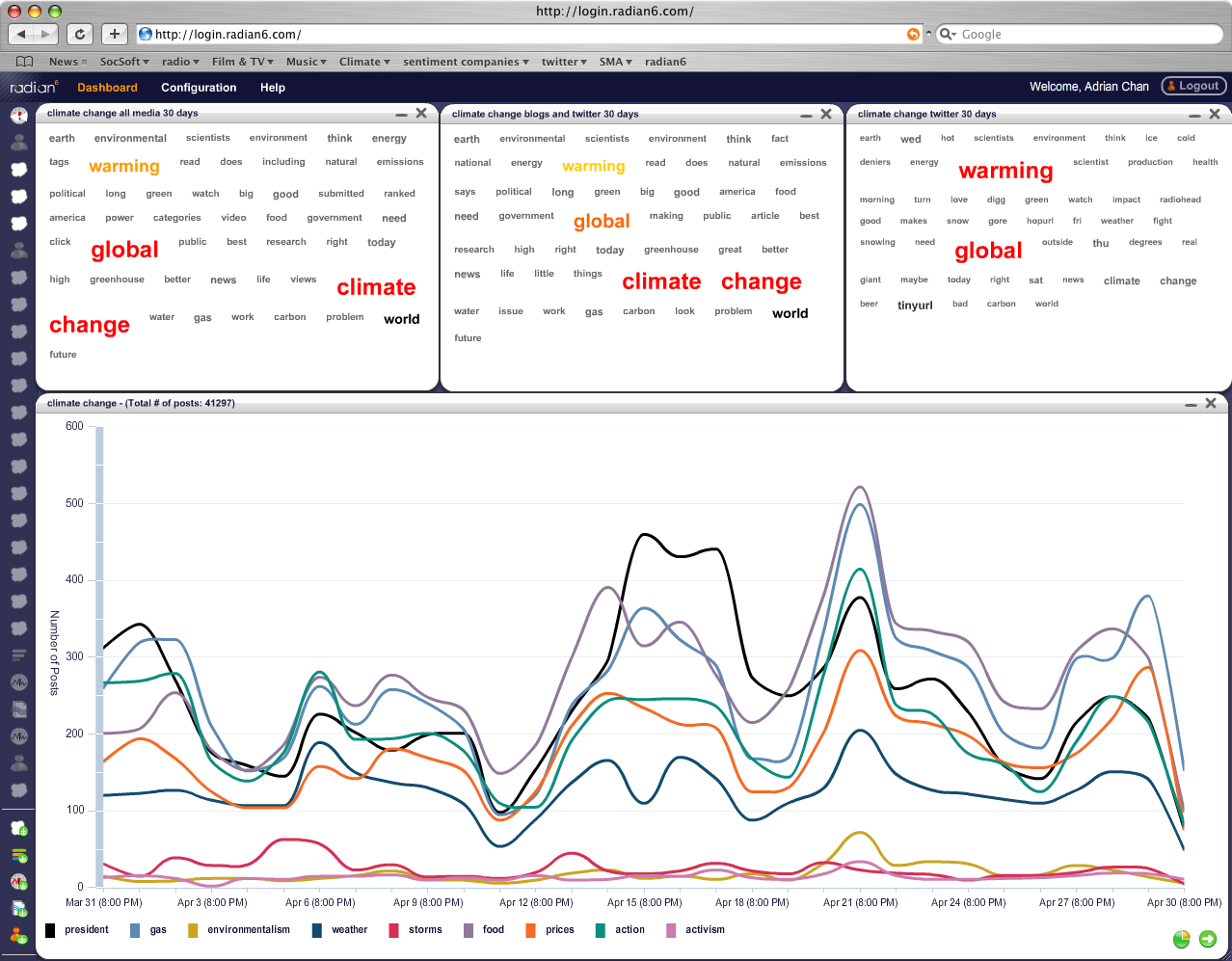
Using Radian6 to investigate social media conversations around one of my own personal involuntary preoccupations -- climate change -- I geeked out this afternoon for a while and have these screen shots to share and discuss. What you see above are three topical clouds created by a search across media types over thirty days for the keyword phrase "climate change." (Click it for actual size.) All media (top left) includes blogs and forums, video, images, mainstream online media, and twitter. The top middle shows results from just blogs and forums, and twitter. And the top right window shows results for twitter only.

Below the cloud panes is a topical drill down spanning the same time period: showing results for terms within the "climate change" results. (In other words, a comprehensive survey would require additional searches. Each results in a bucket of results that can then be further filtered and searched.)


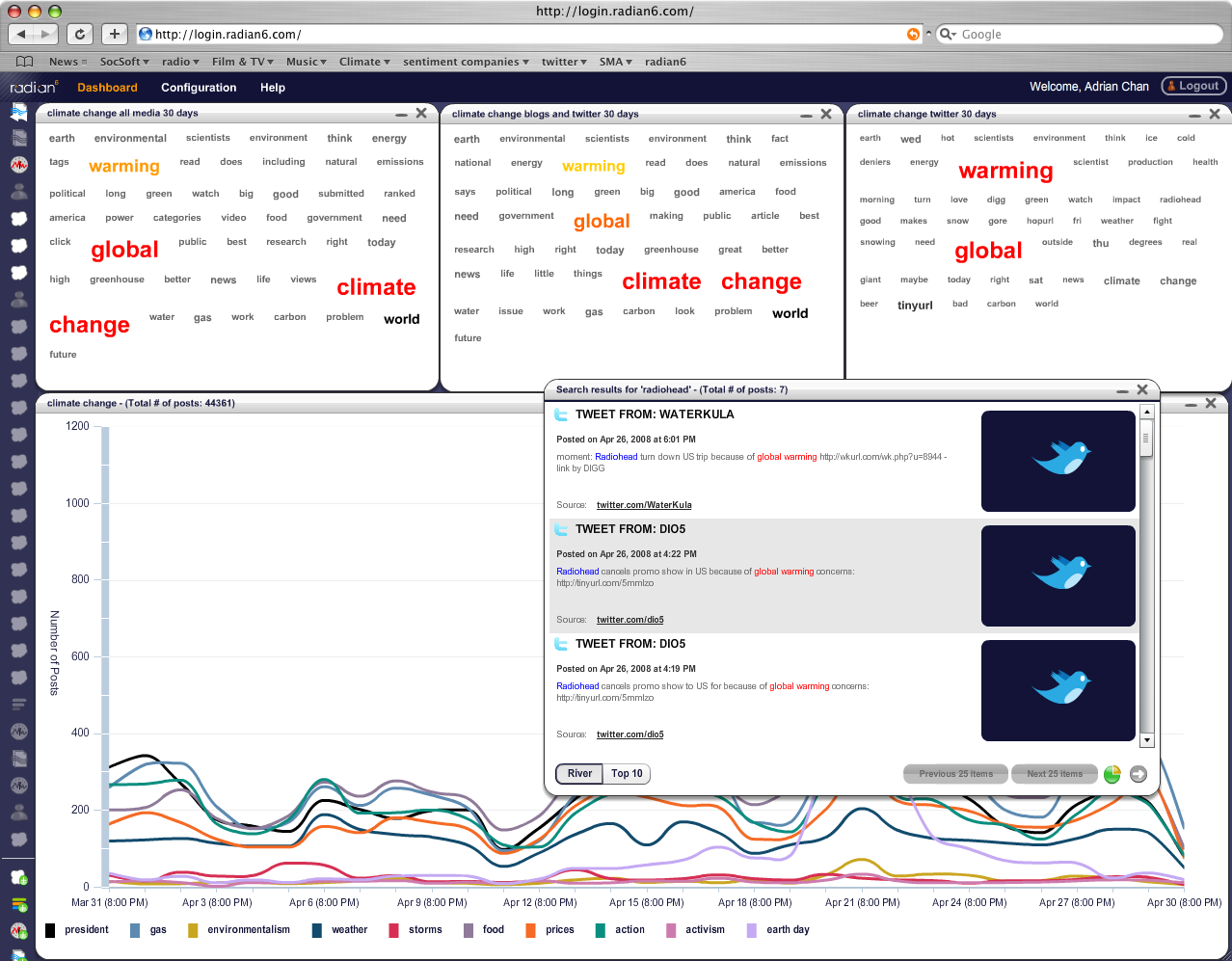
I noticed "radiohead" in the twitter view, top right, and clicked it to see posts. (screenshot on left). Cooler heads prevailing, Radiohead had turned down a US promotional gig to spare the air. True or not, I didn't have time to check.


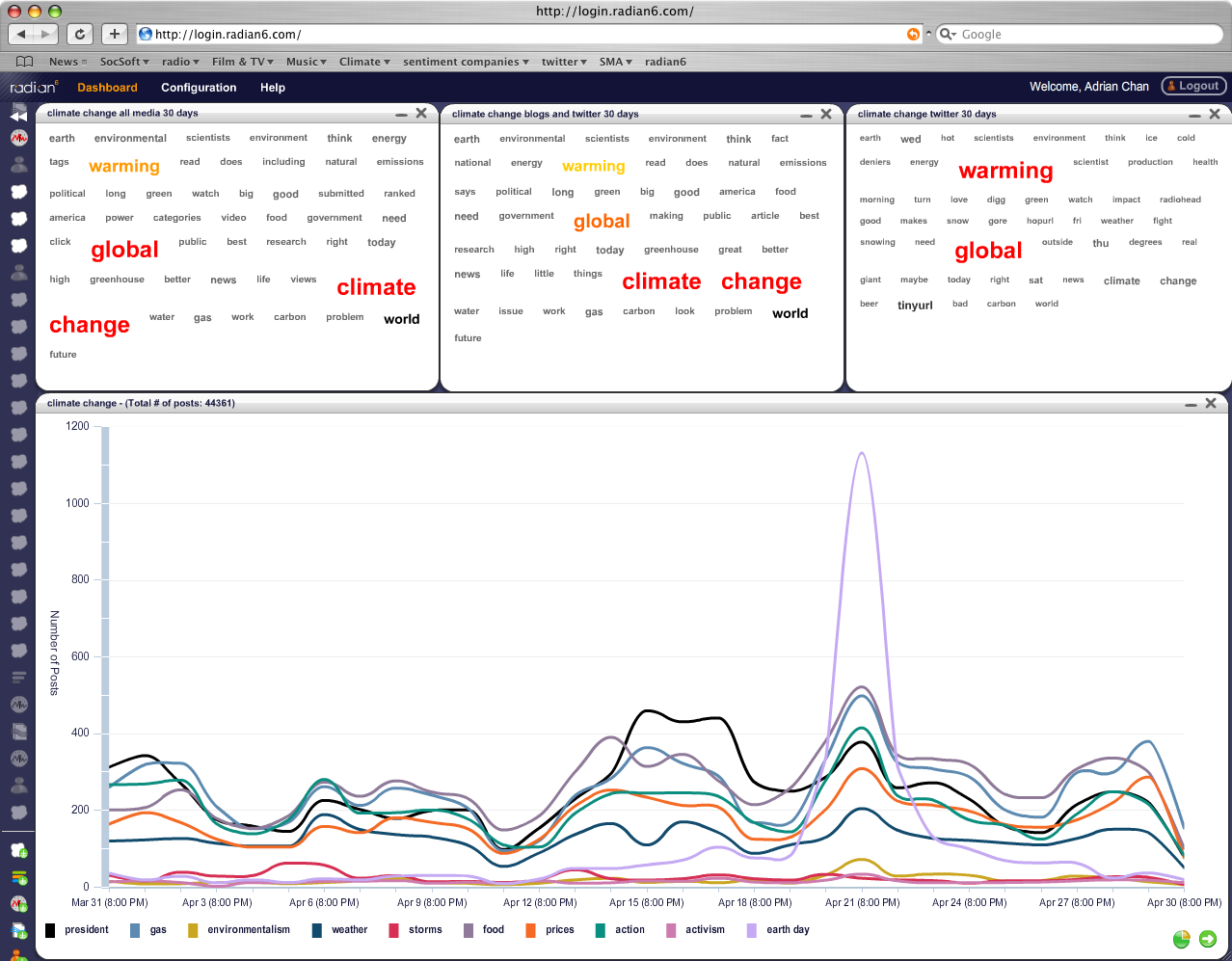
Looking at the results, I clicked the peak on April 21 to see what was up that day. Doh -- earth day. I entered that, and a few other terms, for the screen to the left. (It being earth day every day here in San Francisco, this one had pretty much slipped out through the fissures that crack me up, in my mind, way in the back of my mind.... Ok, honestly, earth day a bit redundant nowadays, isn't it?)


I used the cloud views to find keywords to add to the trend panel. Radiohead didn't register in the trend panel, for example. "Green" is just below "earth day," suggesting that perhaps "Green day" could have taken advantage of some free media coverage (are they still together? I confess I don't recall. Another case of fissure. Fizz-ure... ) Next in prominence on that day were "food," "gas," "action," and "president," which, if I were a writer for The Colbert report, I could have made into a joke, using, perhaps, either "food" or "gas" as the subject of "action" taken against the "president."

Interesting that on Earth day both food and gas were of concern. Food growing or food eating? And seeing as "prices" are just beneath "president," it's possible that food and gas prices may have occurred in Earth day commentary that included administration policies and leadership. Or not. One doesn't want to read between the lines. (Though the lines are pretty close together, and track nicely, so hey, why not?)

As you can see making sense of these verbal trends is not rocket science. Could we have guessed without searching that food and gas prices would come up together? They track with earth day, but to be fair, there was a UN report released that wknd regarding the food crisis. It's possible that they're related. Wouldn't take a poet.

Now what's cool about this tool is that you can read the news sources for any additional key phrases right here. Even view videos. And you can browse a list of influencers (sites and blogs) for the topical profile. Shown here are influencers and a "river of news." Global warming was the biggest hit within "climate change," and shown here are posts that refer to global warming. (Inluencers can be sorted by unique commenters, total comments, enagement (number of comments and length of comment), and topical inbound links.

Now in this view, which focuses on April 20 - 22 (earth day and one day prior and post), there are interesting differences between the topic clouds for mainstream media. Look at the list below. Differences in terms used in the mainstream media, on blogs and twitter, and on twitter alone, are clear. Mainstream media describe a high-level view of the discourse, blogs, commentary on that discourse, and twitter, more personal and actionable conversation.

_____mainstream_____
emissions
issues
america
government
department
public
scientists
national
federal
country
world


_____blogs and twitter_____
save
reduce
live
weather
real
better
information
future
article
action


_____twitter_____
industry
fight
students
right
difference
help
water
citizen
officials
college
sustainability

So far this search has turned up roughly what one would expect of it, and indeed you find what you're looking for when using measurement tools. The benefit of tracking end user conversations such as those on twitter ought to be in the authenticity of twitter talk, and in its speed and immediacy. Radian6, because it updates in real time, can be used to follow these conversations as they happen. That said, it's necessary to supplement twitter talk with blogs and mainstream media, for they provide the narratives, arguments, and semantic map of the conversation space. Topical context is assumed by twitter users (as it is often in chat and IM) -- that context is provided by the slower talk media. At this time, twitter is still very small, and on-topic results for searches on twitter are noisy and fragmented. But for those interested in personal expressions and conversation, and for a read on real-time audience attention and interest levels, there's a lot of potential yet in what twitter can surface.


Note: I did not explore Radian6's tools for influencer results and additional keyword drilldowns in this post.

Labels: , , , ,

Tuesday, April 29, 2008

Social Analytics and Understanding the User

I've been having a fascinating time reading through papers on NextStage Evolution, a company in the business of metrics and online media analysis. And I'm compelled to write briefly on some core methodological principles, primarily because the methodology behind social analytics warrants careful consideration. All of us in this space want to know what the user wants, does, and might likely do. That would be valuable information, and having it would allow us to anticipate and deliver, and engage, with users. Unfortunately, user's don't declare their motives or intentions, and so it is up to analysis to model user interests from user behavior.

I sincerely believe that social media analysis needs to account not only for the user's proximate activities, those being his or her online behavior and actions as trackable by analytical tools (be they within a walled garden social network, on and around blogs, in conversation tools like twitter, or even through social applications and widgets), but also deeper and less available interests. These are the interests that underlie interpersonal interactions, communication, and relationships. And no matter how near or far interactions, communication, or relationships may appear through social media applications, they form the basis of user agency.

Agency is a sociological concept, and it underlies user actions and activities. Agency, to me, involves intentionality and motive, as well as content (information), and is interested (identifies or attaches to an object or subject). User experience is about agency. Interaction design is about agency. And inaction can be about agency, too. Fundamental to the concept of agency is that of self-reflexivity -- that we know what we are doing.

In social situations, activity and interaction are framed. That is, they unfold within a frame, which is to say that they make sense within context, and over a stretch of time. And in social interaction, the frame is often mutually constructed -- two or more people know what they are doing and if asked, would describe the situation they are in with a high level of agreement. Their recognition of the frame would agree even if they are in disagreement with one another.

This contextuality of action, I think, applies to mediated interactions as it does to face to face encounters. The difference is real, but is understood. Some interesting misinterpretations of intent, motive, interest, and so on of course occur online, and indeed can enrich the experience with a touch of play, self-reference, and so on. But as is the case of the comedian who tells a joke about a pope in an airplane telling a story about an ace fighter pilot.... frames can be layered and embedded within one another, and we come out the other end for the most part still making sense.

I bring all of this up because it informs how we read and interpret, and thus also design, anticipate, and model, social media user experiences and social practices. Users provide more than just information and at the same time are less than informing. Our models need to interpret, for example, whether a user has recommended a movie to somebody, in front of a community, to be shared among friends, because she enjoys writing reviews, has a reputable movie blog, is considered (or believes herself to be considered) a movie expert, or believes in the principle of contributing reviews to the common good.

Would we get this from the review itself? Not likely. From envelope information (to whom it's addressed, how messaged, where posted, how delivered)? From comments and their agreement/disagreement? From past movies reviewed? From movie categories covered (e.g. new releases vs film noir). I belabor the point -- it's complex (though do-able). In all cases, however, agency is neither explicit nor stated. ("I hereby submit this movie review to this esteemed blog for the sake of my reputation as a budding film noir critic and blogging habitue".)...

Designing social media to engage users is much simpler than accurately interpreting their actions, for design succeeds as long as users are compelled by their own experience. Users will remain engaged even if the experience is riddled with theft, robbery, and deception. To wit, Vegas. Social interaction designers don't need to know what compels a user, as long as they understand that there is a range of users, and that their system facilitates communication and interaction, as well as an experience of presence which varies user by user, and which leads to social practices in the aggregate. Users work with what is given, on the screen and architecturally, as well as with those others who are present, and participating. Online interactions don't have to be efficient, or even effective, to be rewarding.

But like the anthropologist studying a culture from the outside, or an archaelogist interpreting the meanings of cultural artifacts and found objects, analytical software, as a non-participant, is confronted with a more profound challenge: reverse engineering the artifacts, button presses, posts, comments, ratings, bookmarks and so on left behind by users whose mindfulness or mindlessness would be impossible to measure, and at times difficult to distinguish.

Information about what users do is not available in the information about what users have done.

This is where I tack differently from models based more squarely in data analysis and user activity tacking and measurement. Those methods, and I'm not a qualified statistician, may observe the disaggregated and yet predict in the aggregate, and successfully so, if we are to place any faith whatsoever in the long tail. Metrics may serve purposes of campaign analysis and even management. But engagement (social media marketing) tools would require a communicable messaging and engagement platform. The difference? Agency. Communicable engagement seeks not the acceptance of the user but his or her participation -- it anticipates the significance of agency.

I so strongly believe that social analytics ought to be rooted in an intersubjective framework of action, and not one of information gathering alone, that I'll close with a few quotes from Erving Goffman, master observer of social interactions and mentor in spirit:

"Given a speaker's need to know whether his message has been received, and if so, whether or not it has been passably understood, and given a recipient's need to show that he has received the message and correctly—given these very fundamental requirements of talk as a communication system—we have the essential rationale for the very existence of adjacency pairs, that is, for the organization of talk into two-part exchanges. We have an understanding of why any next utterance after a question is examined for how it might be an answer." Erving Goffman, Forms of Talk, P. 12

"Note that insofar as participants in an encounter morally commit themselves to keeping conversational channels open and in good working order, whatever binds by virtue of system constraints will bind also by virtue of ritual ones. The satisfaction of ritual constraints safeguards not only feelings but communication, too." Erving Goffman, Forms of Talk, p. 18

"And just as system constraints will always condition how talk is managed, so, too, will ritual ones. Observe that unlike grammatical constraints, system and ritual ones open up the possibility of corrective action as part of these very constraints. Grammars do not have rules for managing what happens when rules are broken." Erving Goffman, Forms of Talk, 21

"Uttered words have utterers; utterances, however, have subjects (implied or explicit), and although these may designate the utterer, there is nothing in the syntax of utterances to require this coincidence." Erving Goffman, Forms of Talk 3

"The rules of conduct which bind the actor and the recipient together are the bindings of society. But many of the acts which are guided by these rules occur infrequently or take a long time for their consummation. Opportunities to affirm the moral order and the society could therefore be rare. It is here that ceremonial rules play their social function, for many of the acts which are guided by these rules last but a brief moment, involve no substantive outlay, and can be performed in every social interaction. Whatever the activity and however profanely instrumental, it can afford many opportunities for minor ceremonies as long as other persons are present. Through these observances, guided by ceremonial obligations and expectations, a constant flow of indulgences is spread through society, with others who are present constantly reminding the individual that he must keep himself together as a well demeaned person and affirm the sacred quality of these others. The gestures which we sometimes call empty are perhaps in fact the fullest things of all." Erving Goffman, Interaction Ritual, 91


To put this simply, if it were Prime Suspect (or my favorite, Cracker), vs CSI -- I'd pick Prime Suspect.

Labels: , , , ,

Monday, April 28, 2008

Influencers, Promoters, Inviters and other social media user types

I happened on a local bookstore going out of business yesterday and raided the psychology section, picking up a number of cardinal texts at $2.98 a pop. One of them was Please Understand Me, by David Keirsey and Marilyn Bates, of the Keirsey personality test. Actually, they call it temperament, not personalities. Reading the complete descriptions of what makes up INTFs and ENTPs et al was a real eye-opener, not to mention an entertaining and insightful read.

Character types, modified to account for the effects of social media and related technologies on interaction and communication, and taking into account users' communication styles, relationship preferences, and sense of self and self image, could be a powerful addition to current efforts to architect social analytics and conversation analytics programs.

The state of the art in measuring and making use of social media users and social graphs still centers on relatively straight-forward views of influence, attention, intention, and social capital. While these are more easily measured on closed social networks, a model for analysis of distributed social media tools, including twitter and feed-based apps, is clearly on a lot of people's minds. PR, marketing, advertising, branding, and customer service industries all want in on social media, and whether they stand by the sidelines watching, tracking, and monitoring, or jump into the river of conversation and engage, analytical tools and engagement applications will be essential. Nobody, but nobody, could possibly manage to be in the flow everywhere and at all times.

Traditional mass media approaches to audience metrics may have given us the right questions, and brought us to an appropriate starting point. But social media approaches will be needed now if we're to make proper sense of audience behavior. And here's where character psychologists like Keirsey might be of help.

I have an approach to social interaction design that takes conventional view of user experience and interaction design and extends it to social media users. With an eye to interpersonal dynamics, communication, and social practices, I like to call user behaviors "competencies." Each of us, as users interacts with social media and with others using it according to personal preferences, tastes, and most importantly, perceptions and interpretations. Our social skills online are social competencies. But each of us is different in our uses and, as psychologists would say, our behavior is informed by our psychology.

While this might be looking down the road a couple years, wouldn't an effective social analytics tool, and engagement platform (say, for advertisers and marketers) use not only social metric data but also psychological and personality models? Take the concept of the influencer, for example. As it stands today, an influencer is a well connected, credible, trusted, and active. He or she may also be on topic. That's not currently in the model, but should and probably will be, shortly, as we fold in not only who the person is but what s/he talks about (with credibility). So we might add expert to influencer.

But there are other kinds of user types, too, whose role in conversation can benefit specific marketing, branding, or advertising interests. There's the expert. The inviter. The emcee. The connector. The artist. The follower. And more. Keirsey has 16 types, I've got a similar number, tho based around communication and presencing styles. The inviter, for example, would serve the needs of event promoters. The follower, the needs of PR and news dissemination. The expert validates new products. The emcee gathers together like-minded friends, and would benefit branding or entertainment rollouts.

This is a new medium, and it begs for appropriate analysis. The metrics used in mass media measurement serve the purposes of a medium in which two-way and friend or peer-network constrained interactions don't exist. The future is engagement. Granted, masses of data will have to be mine and modeled. But isn't that what we're good at?

There's consistency in psychology, and applied appropriately and insightfully, durability in behavior and relationships. The noise will subside if we can wise up and if we put users first. If we fail, the doors blow open and a river of spam will inundate the flow. Either way, the mass marketplace is going to enter the stream.

Keirsey temperament overview see:
http://www.simpletone.com/cdi/aharon/types.htm

Labels: , , ,

Tuesday, April 15, 2008

Groundswell Social Technographics quiz, or Some of the Above

Take this social technographics quiz and see whether you agree with the results. I can't agree with mine, but that's probably because I found it hard! Several of the questions were for women (I checked male but the quiz isnt gendered), and frankly it's hard for me to answer anything other than "hire a planner" when asked to imagine that I'm a bride getting worked up for the big day.

There weren't any "none of the above" choices, and the questions and multiple choice answers were highly specific. I agree that "self-reporting" what you think you are may be less accurate than a contextualize question (if you were at a party...), but some of these survey questions offered a tough set of responses.

No wonder I came out as a spectator. I think by the criteria used in this survey, creators are those who want to tell everyone about what they did, think, like, no matter who's listening, and even think about it when they're not online. I'd call those addicts!

On a more serious note, the idea of user personalities is hugely compelling. But the way to organize them, IMHO, is around

--how people communicate (do they talk about themselves, do they like to know who they are talking to, do they like to talk about or with, competitively or consensually),

--how they feel (whether they are sensitive to how they feel online, how they think others see them),

--how they relate (do they get the attention of others because people follow them; because they pay attention to their friends and colleagues, or because they are often group/social participants)

Because blogs, talk tools like twitter, profile-based sites, ratings and review services, mobile and location services, rich media content sites, collaborative writing/editing sites, and commerce/trade sites all offer different ways of engaging. Not all of them require the post-centric contributions covered in this technographic profile survey.

It's a provocative little survey though. And I'm sure there will be some good progress made this year in developing psych profiles for social media users. (I'd share mine right now if they were ready -- but they need more work yet.)


Discover Your Groundswell Social Technographics Profile
Your Result: Spectator
 

Thanks to you, the Collectors, Critics and Creators have an audience. Because you consume the content others produce, marketers try to influence your Groundswell Social Demographic group by reaching the Creators and Critics. With 48% of the US online population, you Spectators represent the largest Groundswell Social Demographics group. Thanks for keeping socialTNT in business :)

Inactive
 
Creator
 
Collector
 
Critic
 
Joiner
 
Discover Your Groundswell Social Technographics Profile
See All Our Quizzes


Take the quiz

Labels: , , , ,