Thursday, September 17, 2009

Social Interaction Design: Structure

This post is inspired by today's excellent reflection On the thoughtful use of points in social systems by Adin Levin of Socialtext. Adina summarizes a twitter conversation that unfolded yesterday among "Kevin Marks, Tom Coates, Jane McGonigal, Tara Hunt, Josh Porter and a few others on the thoughtful use of points and competition in social systems."

I'm going to spin this off in a different direction for reasons of my own, but I highly recommend visiting Adina's post.

I want to address just a few somewhat philosophical points salient to the social media design field in general, and important to my own practice of social interaction design more specifically.

There's an intrinsic tension between three key positions, each of which we should have an understanding about. They are:
  • the user
  • the system
  • the social media professional


Why the third? Because we observe user actions and build or implement social media systems, and therefore have notions about the other two, how they inter-relate, and need to reflect on our notions to better understand how they shape what we can do.

The user has interests and motives that we will never have complete access to — in fact by most accounts the user himself isn't aware of the reasons or causes of all his actions and choices. But the user matters to us because we do claim to take a user-centric approach to social media design. And not for no reason: capturing user interests and producing compelling and engaging social experiences is what it's all about.

And we recognize that there's this vast and complex social field there in which all manner of reasons, motives, incentives, interests, goals, and what have you that might account for what users do, why, and whether they will do it again. We won't know all of that, but for that we should not consider the user a black box, or explain user behavior on the basis of causes external to him or her. The user supplies his own motives and experience.

Now there's a natural tension between user-centricity and design. For the explanations of user action are subjective — anchored in the user's own stream of activity, and embedded in the user's experience of friendships and social structures that span time and space.

Design, however, needs objectivity. Things, elements, operations, ordered in support of functions having functionality. In short, uses.

Now, in the old days, that is, pre-social software, we could conflate the user and the use case. All was neat and tidy. The user was what her use of the software was, the use case described that use, and the system's success was a clear binary situation. We could describe users by their needs (I need to do this "because of" motive) or goals (I want to do this "in order to" motive). These supplied the utility served by means of transactions with the software. Easy pass/fail system problem: was the software successful, efficient, and effective.

Design requirements could then be articulated on the basis of user flow, activity, or action sequencing (wizards step the interaction for simplicity and effectiveness). And more. The point, in other words, being that we could structure user action with elements, codify button functions, articulate requirements for screen content, layout, and navigation, and even structure time. Then, according to the system's primary functions, we could filter data, sort results, and order them on the screen — using many tried and tested best practices.

Now, as professionals interested in designing and building social media, we need to consider a) the user experience b) the system design and c) our own perspectives and understanding of how a) and b) inter-relate.
  • We can take a roughly causal view of it: the user responds to design constraints.
  • Or a normative view: the user is constrained by the norms and values of a community of users
  • Or a functional view: the user has needs and goals, and uses social media to accomplish these with and through other users
  • Or a psychological view: social media present an external psychosocial world onto which users project their expectations, and from which they internalize the meanings of interaction outcomes
  • Or a communication view: users maintain relationships and engage in communication through social media as they would in daily life, with varying notions of what social media are, do, and of the people who use them


And there are other views, some of which pertain strongly to brands (users have passions), to marketers (users consume brand messaging), to mass media (user eyeballs have moved to social media), to customer service (users have the power), and so on.

My point being that each of us, as social media industry practitioner, likely has a take on this that leans in some direction or another.

I often find that design, engineering, and product folks tend to have more objective explanations of What Social Media do and how they work. Marketers, PR, Sales, etc have a more people (user) centric view. And so on.

We need both, but we also need to know the limits of our own perspectives — else we run the risk of confusing what it means to us with what it means to the user. And of confusing how the design works with what the user is doing. They are not the same.

Social interaction is a particular kind of action. Social action is oriented to another person. It has the relationship of "I : Thou" or of "We." Now the fact that social media are media — that action is mediated by means of design elements that have their own "meanings" and by language as writing, sight as image or recording, and interaction through navigation — this all matters, for any social action is not directly social but mediately social.

Terms like proximity, connection, relationship, conversation — we need to recognize that these are terms applied to a world that is phenomenologically constructed and ontologically absent. Or better, imagined. I am, now, typing into a little box talking to you, attached to a little box. Terms we use to describe the social evoke precisely the social attributes that world is missing. It is missing proximity, connection, relationship, and conversation. Just a point worth making.

Clearly this point serves little purpose aside from dusting off our idiom a bit, but clarity in perspective requires a good wipe now and then.

So, to where I wanted to go with this. Social interaction needs to accommodate users, as individuals. Needs to accommodate users with other users (social action, communication, and social practices). Needs to accommodate design (structure of elements and resources, rules, functionalities, and systemness: structure in and over time).

Anthony Giddens has a nice take on this. His view, called "structuration theory," claims that social structure is a duality: it is real, but doesn't exist unless reproduced by people constrained and enabled by it. The user has agency, structure constrains and enables action. This is perfect (IMHO) for social systems.

He makes three helpful distinctions around structure:

  • structural principles: Principles of organization of societal totalities
  • structures: Rule-resource sets, involved in the institutional articulation of social systems
  • structural properties: Institutionalized features of social systems, stretching across time and space


I find these very useful. For the challenge is in trying not to confuse design and structure with causality (that a user responds to constraints). And it permits seeing the ways in which social "stuff" happens when users begin, haphazardly and around a particular tool, app, site (etc) to form practices (the sticky). For social practice is structuring: relations, behavior, expression, meanings.

There is "structure," then, on the social side and on the design side. And in between, the interactions and communication are how the whole thing is reproduced, constantly, daily, all the time. (And why flow and streams are such an important shift.)

There is more to say here on interaction and communication (language has structure, interaction has structure), and how users use each to relate to each other, while also supplying the juice that turns the social media engine. But this was meant to be a quickie and I don't want to violate your sense of good and proper form.

(I will say, though, that I think it's in articulating social practices that supply social organization, use of symbolic elements that stabilize meanings used in social media (little design features, nav, icons etc), and then how the system transforms communication into infomation and social content, about which it offers system messages, views, aggregate data as a reflection of the system on its own use by users.)

So I think that as we move forward in our approach to designing the social, we might reflect on our positions and approaches. By doing so, we might shape the field, and I think it's an emerging one, so that we can see how practitioners with different areas of focus and experience fit together.

Labels: , , , ,

Wednesday, September 16, 2009

Activity Streams: Content and Flow

The realtime trend continues unabated, with presentations at TechCrunch50, Facebook's recent updates, and next-generation newspaper designs all extending the impact and value of the stream in social media. Disaggregation begets reaggregation, as demonstrated by the newcomer threadsy this week. As client applications and new services add organization and structure to activity, news, status, and twitter streams, we see hints of what is likely to come in the months ahead.

I think there are two distinct trends at work here. One, the popularity and adoption of the stream as a form of social conversation. And the other, the conversion of realtime information into value that can be consumed outside the stream. Or to put it another way, the value of being in the flow, and of watching it from the river's edge.

These trends lead to some interesting implications for social media professionals, from designers and developers to brands and businesses. We'll take them separately, and for simplicity's sake distinguish them by interaction "in the flow" and interaction "around the flow." Interaction in the flow is conversation and talk itself — in the form of tweets and updates distributed among friends and across various social spaces. Interaction around the flow involves the value-added actions and activities that use social content, such as rating, diggs, tags, and so on.


In the flow
Many of us are in the stream to communicate. We use the tools available in ways not entirely dissimilar from the ways we have used message boards, IM, chat, and email in the past. We experience it as a kind of online talk. Here, the interaction systems emerging around stream applications focus on ways of improving communication. Twitter's @reply and retweet are examples of these. So, too, is Facebook's recent adoption of activity tagging. Feed readers for streams both reaggregate these distributed conversations and provide for interaction within.

As in all forms of talk, the critical design and experience elements and features include addressing (individual, social, and public audiences intended by the user), subject or object, topic (hashtags, tags), time stamp, and other references (could be @names or could be links). Other distinctions not yet supported would include other linguistic types (request, invitation, answer, greeting, etc), urgency, commercial/individual, and more.

A lot of interesting things happen around conversation and designers are only beginning to wrap their heads around the possibilities for surfacing value, extracting meta data, structuring and organizing talk itself, and so on. Because the primary value of the user experience lies in communication itself, the possibilities are virtually endless.

We can easily imagine a wide range of activities that are currently page or site-based being handled instead by the stream. Invitations, meeting requests, buying and selling, questions/answers — these and much more could be transacted by means of messages "off the page" and extracted or sorted out of streams by smart clients or aggregators. Analytics companies will have a gold mine of relationship data to scrape and visualize, for example, for use by those who want to see how influencers reach their audiences, around what topics, how quickly, with what redistribution, and so on.

The conversation space holds many more opportunities than we can currently take advantage of, in part because many applications are still trying to simplify the experience of being in the flow. At present this requires aggregation of messages posted across numerous contexts. Over time, however, it seems inevitable that conversational tools will be able to offer not only the direct messaging experience but also a variety of benefits from use of metadata, analysis, search, and structure/organization.


Around the flow
For those who spend less of their social media time in the flow, there are the interactions with content instead of person. Many of the long tail services create value through interactions with content that are designed to surface and rank by popularity, trend, similarity, rating, and so on. This is the world of taste-making, and it uses indirect social interaction (meaning not person to person communication) to qualify social content items. Recommendations services depend on the contributions of users to qualify and differentiate content: the more ways there are of differentiating content items, the more ways there are of relating it and providing navigation through it.

The primary goals of interaction models used around the flow involve separating content from the conversational stream, extracting meta data where possible, assigning categories and embedding within content structures and navigational systems. Then the social challenge becomes making it accessible (search, browse, and categorization) and making it socially interesting (lists, rankings, votes, etc).

The disadvantage this older page-based method of social experience has with respect to the recent conversational trend is of course that it's at a remove from the user. The factors that compel us to talk are not available here. Attention is not paid to people directly, but indirectly through means of content. The advantage, however, is of course in the many ways already developed for organizing content and making it available for re-use within other contexts.

[Note: All interactions with social content first involve a selection of something. These indirect kinds of social interaction assign value to the content item (a vote up or down, a rating, a favorite, a tag, etc). Selections in the stream, by contrast, create value by distributing (sharing, replying) communication. There is a critical distinction between the direct communication interaction model and the indirect social action model. Communication uses language; social action uses symbolic tokens and signifying systems like emoticons, icons, ratings, votes, etc.]

...

In each of these two trends, value is in the relationships, either between people or among content elements. Communication itself creates value, but of a kind known best by those involved and extracted only with difficulty. Social content can more easily represent value assigned to items, but must then find ways to restore what made it interesting in the first place.

One could see a new breed of social networking experiences built around messaging, if conversational features can be codified and structured for ease of participation and consumption. It will be interesting to see whether or not this happens. In either case, the emergence of interaction models appropriate for communication and social participation, to streamline communication and to make social content a more interesting experience, holds a lot of promise.

Labels: , , ,

Monday, September 14, 2009

Social Interaction Design simplified

I have been asked recently to explain Social Interaction Design (SxD) in simple terms. What it is to design and designers, and to user experience design fields in particular (interaction design and information architecture). But also what it is to social media in general, including application development, social media business design, strategies, and their execution.

Folks who know what I'm trying to do with Social Interaction Design know that I'm after a description of individual and social practices around social applications that starts from the user experience. This is important to me and to the theory and framework of SxD for a simple reason. If the framework is to be accurate and valuable it needs to account for social dimensions intrinsically (not by metaphor, analogy, or anecdote). That is, grounded in the individual experience. For there is no "there" there in online interactions — all communication and interaction is lifted out of the context of place, and dislocated from the continuity of time and presence that frames our face to face encounters. (Social interaction online is not "like" interaction face to face, but is different for reasons worth exploring.)

Starting from the user experience also forces the designer, architect, marketer, strategist, or other social media professional to think from the user's perspective. Thinking from the perspective of product, problem, solution, utility, or branding is fine, but excludes the experience: what people do, why, and how many people "together" produce social outcomes.

The user centric approach here is deeper than it is in conventional design for the simple reason that social interaction involves users interacting with users. Not with the screen, with functions, features, elements, content, navigation, or what have you. And not with the brand, product, or service. Users don't talk about brands, they talk to each other. How they talk to each other in ways that also bring attention to a brand is what is interesting to me — and requires a more holistic approach to social media than use of media as media.

....

While I resist anecdotal descriptions for the reason that I'm after the dynamics of social from a view of participation, I'll use one here to see if I can better convey what I'm talking about.

Take a lunch. Lunch is a meal. One might explain it as a means of satisfying the universal human need to eat food. This would explain lunch from the perspective of satisfying "needs." This is true, but it's an inadequate description of what goes on when we're having lunch

[Google meets our "need" to find information.]

For example, there's is the matter of what's for lunch. Lunch has content. The food itself is not just food to be eaten for the satisfaction of metabolic conversion into energy. It comes in all different forms: recipes, menus, dishes and all the rest of it.

[Twitter has created a new form of talk.]

But the lunch itself is also not the sum of it. Our fellow diners have different tastes, and what's tasty to one may be just so-so to another. If food tastes good, "good" is not an objective property of the food. It's the experience of those of us who think the food is good.

[Foursquare combines the social of popular places to go with the personal recommendations of things we think are good.]

But the meal served, good or not, is again not the sum of it. Where are we going for lunch? And what's "where?" In choosing where to have lunch together we may run through many different kinds of restaurants, and compare them on the basis of quality, price, reputation, style, ambience, and so on. (Is it hip?) Regardless of which attribute we agree on, and by which we choose our lunch place, the value choice we have made is not objective either. Value is in how we value. What's a valid reason for choosing our lunch place, say "it's new and it's getting popular" may not be valid for another (it's overpriced; it's not the real thing).

[Yelp is about taste and opinion. Reviews illustrate the many ways in which users disclose their tastes, identify with merchants, and express their values.]

And what about who's going? Are we friends? Co-workers? Are we having a work lunch or lunch to catch up with each other? Surely these are important social aspects of going out for lunch.

[Linkedin social practices, even when their design is similar to Facebook, are social in different ways.]

But in these respects, then, what matters more: the type of relationships we have (eg work); the status of our relationships (one of us is tagging along); or how we feel (bummer, because now we're going to have to listen to him complain about the boss)? If we talk about how relationships affect the experience, we have to acknowledge that there are different ways of characterizing what a relationship is.

[Facebook is popular in part because there are so many ways to engage and relate to friends near and far, new and old, from greetings to games]

And there's our communication and interactions with each other. Are we boisterous and comfortable with each other? Do we bring work to the table? Do we have lunch to talk casually about work, or because we genuinely like each other? Both, of course, could serve friendship, or serve our workplace.

[Social practices vary significantly from dating to jobs sites.]

If in fact this is a working lunch, then the social context is actually "work." Our lunch is an extension of work insofar as we continue relationships with each other as employees in a non-work environment. But this makes us better co-workers, improves the basis of our appreciation for each other, and helps out our communication. As a work lunch, this lunch works (is work of a different sort).

[Social media in the enterprise don't work the same way as public social media.]

And so on we could go. We could talk about plates and silverware. We could talk about the space and its design. Its location. Or we could talk about the service and presentation. None of these would describe whether we enjoyed lunch, or account for the "experience" in toto. None would explain why we had lunch, or be able to predict whether we will do it again (and how soon).

...

I have dramatically over-simplified this example to show that there are different ways of observing social practices, describing them, and accounting for their elements, their organization, value, social routines, and social significations.

We see similar differences taken every day in how we describe social media. You and I will at times use industry trends, business transformations, technical innovation, social habits, information needs, communication practices, designs, features, types, and more to describe What goes on with social media and How people do it.

We might attribute the medium's popularity to changes in how we connect with people. To how we talk and stay in touch. To disruption in the marketplace. To the demographics of various audiences and their use of social tools. To the fortunes of big players and the ecosystem of application developers. To the periodic success of a product or service and its trickle down effect in copying and extending hits like the iPhone or twitter. To the cultural trends like personal branding, status updates, blogging, social networking, and many more.

My aim with social interaction design is to contextualize these various and valid descriptions and observations, but to seek a deeper accounting of the user's practices and how they add up to the social practices we see, and will see emerging, in social media. My hope is to help to shape the field in ways that will result in clear assessments and insightful and useful explanations — connected, ultimately, to human experience.

Labels: , ,

Wednesday, June 03, 2009

Users: which is which, and who is who?

Who knows?
On the phone yesterday with friend and colleague John Cass (SNCR), he happened upon an interesting topic. One for social media professionals of all kinds: designers, builders, funders, pundits. The question came up: doesn't our expertise, built over years of spending time online, qualify us to see what's really going on with social media? How it works and doesnt?

Or, on the contrary, does one have to be in the target market, amidst the majority of users, to know best what's going on?

Who knows best -- the person with the most experience in the technology, or the person most like the mainstream user? One is old, one is young. The older person may not know what's most hip, hot, cool, or in. But the young person may not have yet learned things, call them technology's symptoms or side effects, that the older person has.

I was reminded of a debate that plays out among anthropologists and other cultural academics (those who study human "sciences"). Take a culture, a new, foreign culture. It's texts, rituals, pastimes. We want to study it, to understand what's going on, and what these practices mean. But we have a problem: as outsiders we cannot know that our interpretations of the practices are accurate. We are not on the inside; and therefore we don't know the validity of our observations and interpretations.

It's called the "hermeneutic circle." Inside the circle, one knows by right of membership and practice what's going on. Being on the outside, one can only observe as an outsider.

So cultural anthropologists turned to comparative techniques, and by comparing and contrasting practices across cultures, drafted a set of structural principles and descriptions. The method is simple enough: look not at the content of a ceremony, but its structure. Look not at what's on the mask, but on which member of the tribe wears it. Look not at the dowry, but at the obligations and debts that flow back to the family that has paid it.

Rules of the game, not the game play itself.

This distinction occurs again in communication theory (especially in pragmatics). Language is not speech. Language is the system in which meanings can be preserved and through which they can be reproduced. Speech is the performance of communication, and uses language as its means of expression.

We are, it is said, unique among creatures in our ability to separate the meaning of statement from the performance of a statement.

What am I getting at? Designers ought to recognize where I'm going. As a designer of social interactions, John and I had to ask, who knows better: the teen who uses Facebook or the old guy who knows social media? The user or the observer? The performer or the structuralist?

Which is more meaningful: how social media is being used, right here and now, by these people. Or how it works, across different applications, regardless of who is using it?

Who knows best? The insider or outsider?

I do not have an answer. Both, I suppose. The user may know this application, or use case, best -- but know little of why. (So it goes anyways in cultural anthropology: the member of the group knows what's happening but doesn't have a reason -- it takes being an outsider to think in terms of reasons). The observer can see the structure, function, and process, but may not be able to play the game.

As many folks know, I come and go with social media for the reason that I have to be in it to be a user -- but out of it to reflect more freely on it. As it happens, coming and going is also good protection against burnout.

I recently took time out of twitter to catch up with some sites and services that i hadn't used in a long time. Built a small dbase to capture notes on screens -- in the hopes of writing about the grammar of social interactions.

I had to write this piece to get the question out of my head as well as to raise it among professionals and practitioners. We know that our own experience(s) on social media are neither universal nor common. Most of us have been doing this for a while -- and are no longer captivated by novelty of technique, result, or effect. Many of us are (variously) strategic in our uses of social media. We may have reputations to keep, peers to respect, tongues to bite.

So how do we know that we know better or best? Knowing the technology isn't enough --it all comes down to user experiences in the end. "Technology" is a thing, and social media are not "things" but are actions, interactions, communication, and distribution. One might describe qualities of a thing, features and functions of a thing and entirely miss what it can mean, and how it might help make meaning.

My own personal take on this is that one must first admit to multiple users and kinds of users. Multiple uses and use cases. This might seem to be stating the obvious. But I have heard time and again, from those who should know better, that "social media is ____". That what it is, is based on that person's experience.

That said, we have to make observations. Simply knowing the user experience is (if it were possible to know many) still not enough. Knowing what it's like to drive doesn't make one an auto maker. Process, function, design, architecture -- those things that will ultimately facilitate and help produce an experience for (many) users -- these are structural forms and rules necessary to build by. Structures still empty of users are still structures. Structures inhabited lead to habits, in time.

At the end of the day, because there is no one right, global, or universal experience or perspective possible, the professional's I think comes down to flexibility. An ability to shift perspective, to take perspectives, and to contextualize an application or user audience as clients (etc) demand. It then becomes a matter of changing one's own mind.

I think the designer's approach is as much his or her own mental awareness of the problem space and opportunities, of familiar and common forms and actual uses and practices, as it is anything else. This ability to be in, or out; to know how it goes, but also what makes it that way.

Labels: , , ,

Friday, April 10, 2009

The Inmates Have Requested Asylum

I spent much of yesterday afternoon listening to podcasts from a conference I wish I had attended: the IA Summit. The podcasts are up on Boxes and Arrows (thank you Chris Baum!) and are well worth a listen. I also found that they looked good in iTunes with the visualizer turned on.

I don't know that I'm an information architect. I was a web developer for seven years but eschewed acronymic attributions on principle and felt that most of us were making it up as we were going along. The design agencies that billed for process and methodology took the designations most seriously, it seemed, and had the design talent that gave them the right to do so. After the dotcom crash many of those methodologies were shelved, as budgets for web work drew the line item for process out of the picture. The industry was commodifying, rates tumbled, and there were few compelling development projects available to small agencies. For a while many of us developers were working like architects being asked only to paint the exterior of a house. The real building contracts were fewer and farther between.

Then the social web began taking shape, and things got interesting again. I removed my entire web portfolio from my site and hunkered down to think about social software. Fascinated as i have always been with social interaction and communication -- in theory and practice -- it seemed to me that new opportunities would emerge for what I started to call "social interaction design" (SxD). I was not so allergic to labels after all -- as long as they were my own. And i pretty much kept to myself, doing startup work and thinking about a conceptual framework for mediated social interactions.

Listening to IA pods yesterday got me thinking about where we now stand. IA, IxD, UX, separately or together is not so important -- the institutional taxonomy and territorial distinctions being beside the point. For I have yet to see an IA drive a social media design or experience. Yet to see an interaction designer lead the team. Yet to see a user experience lead define what a social media application will do or how it will work. From my limited experience in Web 2.0, engineering drives features, marketing drives branding, bizdev drives platform interoperability and open-ness, and web design drives UI, navigation, information architecture. A coffee house, co-working space, or apartment serves as the shop or studio. And process is determined as much by whatever everyone else is doing and launching as it is by internal startup dynamics.

There is no high-level design methodology for social interaction or social media development. IA, IxD, and UX are regarded as a luxury, considered an unnecessary use of funds, and are largely irrelevant and out of the picture. How is it that the very field that should be in front of social media trails it so badly? Why is it that we are still trying to define a tidy set of concepts, for identity, presence, privacy, messaging or what have you, while "web 2.0" startups are out there making this stuff up as they go? Why, failing the means by which to understand social interactions well enough to anticipate them ahead of time, are we cooking up dishes to throw them at the wall in order to see what sticks? Is agile a design process, or another way of saying "we don't know what will happen?" Do we not know what will happen because that's how social media works, or because we don't know how to look at it?

I don't have answers for these questions, but I have suspicions. I do think that design organizes and shapes the user experience. i do think that user experiences, together, produce social practices. I do think those social practices are consistent -- with the designs that facilitate them as well as with the social themes and activities by which we all "know what we're doing" and "what's going on," socially. Something has been built, that something is constrains and enables, and decisions have been made. But our field, the design of social media, is lacking the language and framework by which to conceptually grasp and reasonably anticipate (if not predict) design outcomes. In their absence, it is funders, technologists, marketers (all due respect, but they have their interests and competencies and they are often not user-centric in nature) and visual designers who are making the decisions that shape what a product is, how it (is supposed to) works, by whom it is enjoyed, and what their enjoyment will leave behind. And in the absence of clear thinking and an understanding of mediated social practices, our next best option is to rely on best practices -- which, we know, do not travel well and are frequently lost in translation. (All social media do not need twitter.)

it's nigh on the hour that we begin to furnish the industry, and ourselves, with a solid set of concepts for the "design" of social interactions. They can be obtained and drawn from insightful and principled works in sociology, psychology, linguistics, communication theory, and symbolic interaction. For the inmates have requested asylum. They're not in the asylum. We've misunderstood the very word "asylum." it's not a place that "they" are, but something they want. Design of social media is not containers and spaces, is not identities, mug shots, and IDs. Presence is not roll call and privacy is not just control. People are the content, they're not the contents. I get the sense that in our predilection for design and our visual-mindedness, we have become too comfortable with spatial architectures and confining spaces. That in our emphasis on the user we have forgotten her experience. We treat users as objects, put them in little boxes, and watch them from the panopticon that has been at the center of any post-industrial prison since the idea of control regimes was first thought up.

Design of social media is not a visual problem, as design should not be a method of control. Design should refer to how we think about social media and social interactions -- not something we do in order to design the user's experience. Design should, in this case, be our discipline and conceptual practices. Design should be what we create in order to anticipate individual and social experiences and interactions -- with all of their contingent, dependent, and temporal dynamics intact.

Joshua Porter mentioned, in one of the podcasts, the case of corporate plazas. This oft-cited tale tells of how corporations failed to realize that in their aesthetic self-aggrandizement, they had built plazas and lobbies for themselves that looked good but were barren and bereft of life. William H Whyte, a must-read for anyone doing social, was one of the pioneering researchers to reclaim public spaces for public use and consumption. He proved that we like, and in fact want to be in the midst of, streams of social activity and noise. But he also demonstrated that it was not design, but humans, who negotiate and determine the flow of activity. Subway users in Tokyo, he discovered, could get through a revolving door and to a train in numbers and rates of flow exceeding the theoretical design limits of the door itself.

I worry that unless we catch up quickly, social media will continue down self-reinforcing, and thus increasingly un-imaginitive, cycles of best practices. That we will be left to design corporate plazas. And that we will do so with a taste for the neat and tidy that is our preference as practitioners, but which will only result in lifeless and unsatisfying boxes, and, well, arrows. Imprisoned in the structured containers of thought of our own making. While the inmates, having long left the building, scratch their heads in the yard.


There is so much to learn by thinking outside the box.

Labels: , , , ,

Thursday, February 05, 2009

Social Interaction Design Primer II

I'm publishing a six-part update to last year's Social Interaction Design Primer on JohnnyHolland.org, where I am a contributing blogger. Jeroen Van Geel has been doing a fantastic job since launching this interaction design community blog, and I'm happy to contribute to conversations unfolding in the design community about social media there. In this primer, I attempt to sketch how a framework that accounts for social action might be applied to the forms of experience and interaction design common to one category of social media: lifestreaming. Please join in!

http://johnnyholland.org/

Labels: , ,

Thursday, December 04, 2008

Social Media Personality Types: Slideshow

This slideshow has been laying about for too many months now so I've decided to wrap it quickly and push it out there. It's a distillation of a much larger project I've been pursuing and which I hope to write up and post as a white paper this winter.

Having covered the screen and functionality of social media from a social interaction design perspective, the next piece in the puzzle had to be the social media user experience. These personality types are an attempt to distill out just some of the different user experiences had on social media into personality types..

The idea behind this slideshow was to make the claim that we must all have very different experiences of social media: in our sense of connectedness, visibility, popularity, in what we think it is for and why we use it. These differences ought to matter not only to any user experience or interaction designer, but to any business interested in commercializing or profiting from social media.

It has always seemed to me that the conventional market segmentation of user types (influencers etc.), while perhaps identifying broad categories of users, fails to account for the user experience. Surely, influencers do not relate to social media as influencers; followers as followers; and so on... These definitions aren't grounded in a framework of motive or intention, and therefore fall short of explaining behavior based on the user's competency as a social media participant.

This slideshow attempts to sketch a view of users based on personality differences that takes mediated communication and interaction into account (I don't know of any personality models that have been customized to non face to face interactions). This means adapting personality types for the unique ways in which social media represent us to ourselves, represent others, present and facilitated social activities, and so on. It means taking personality types and anticipating what, in social media, would engage them, motivate them, and compel them. As a sketch, it is incomplete and intended to kick off discussion.

Social Media Personality Types
View SlideShare presentation or Upload your own. (tags: social media)

Labels: , , , ,

Tuesday, October 14, 2008

A Social Interaction Design Primer

Current business conditions are unforgiving, and seem to be taking their toll on the social media industry, whether it's in the mood on Sand Hill, in the decline of online advertising, or even in the prognosis for Web 2.0 at large. I penned a reflective piece yesterday in which I suggested that companies in this space do more to enhance the user experience, or suffer through the coming Darwinian fight for survival. While execs work to define their business models, I'd like to attempt to capture the basics of social media user experience. For the business all of us are in, at the end of the day, hangs on the participation of users.

Years ago Alan Cooper published a book that has become a classic among designers. Titled Inmates Are Running The Asylum, it set a framework for interaction design based on respecting the user and her needs, goals, and objectives. User-centric design is now the de facto approach taken by software, product, interaction, and all manner of designers, including social media designers. In fact our industry, perhaps more than any other, relies on delivering compelling user experiences for its success. Users are our business model, and failure to engage users not only kills participation, but all other aspects of a social media company's business also.

As a self-proclaimed social media expert, I'm often asked by companies how to "get users to do" more of this or less of that. Clients understandably identify with their product, and with what they designed it for. But in social media, users do what they think a site or service is for, and not necessarily what it's designers intended. So I begin an engagement by asking clients to view their product from the user's perspective. Many small companies do not have a user experience designer on staff, and rely heavily on best practices to steer feature and interface design.

But user experience matters in social media are more complicated than in non-social software. For example, the conventional user-centric view starts with user needs and goals. In social media these are not necessarily rational and objective. They can be much more psychological, and social, for example. Furthermore, the interactions that users have are not just with the software application -- they are with other users (through the software). The UI is not an interface to discrete actions and transactions (such as your online banking site); it is a social interface, and through it users feel like they are interacting with friends and audiences.

This complicates matters somewhat for the standard interaction design approach. If the task of conventional software is to provide successful interactions, to inform the user that his actions worked, then what of social media? Communication is by definition an open-ended transaction, not a discrete one. Take the example of a dating site: one user pings another, by messaging or gesture, and hopes to hear back. Does the software designer want to provide a status message about the recipient's interest? "Your message was received but she's thinking about it. Please be patient."? Likely not. In fact, the dating site wants to keep its users on the hook for as long as possible. Ambiguity is in its interest -- not clarity and transparency.

We can go one further in distinguishing social interaction design (as I call it, or SxD) from standard user experience and interaction design. For in social software, failure works. Take twitter for example, which is not used for SMS-Web messaging as originally intended, and which hooks many users because in social communication and interaction terms, it is kind of upside-down and in reverse. Users don't choose who they are talking to. When they post, their tweet appears in "thread" that is a false representation because their post appears next to the tweets of those they follow, not those who follow them. And there is an asymmetry between posting and reading such that users are required to declare their presence. Where a chat room or IM application is designed to capture users' presence, twitter does the reverse. Users have to declare their presence and attention by using (@ or direct messages): "@username, Nice post!"

Social interaction design works by respecting the psychological and social, the ambiguity not the clarity, the unintended not the intended. The best a designer can do is set up a social architecture that structures and organizes participation well enough that users know what's going on, and therefore what to do. Social interaction designers start not from user needs but from user interests.

The bottom line for any social media company is know your users. Here again, social interaction design differs from non-social design. There is not just one user. There are not even several "personas." Instead, users differ by their communication and interaction styles, their ways of being social, their understanding of what they are doing and of what others are doing. For simplicity's sake, I segment users according to three types of interest: Self Interest, Other Interest, and Relational Interest. This comes from contemporary sociology and psychology, and goes roughly like this:

Self-interested users act from a position of Self
Other-interested users react to an Other (user)
Relationally-interested users interact through social activity

To provide a few examples, there are Facebook users whose activity centers on their own profile, which is a representation of their Self and an extension of it (into the mediated social world that is Facebook). These users may not even visit their friends' profiles. They interact around their own status updates, wall posts, profile page elements, and so on. Then there are Facebook users who spend more time browsing their friends' profiles, posting to their walls, reading their friends' updates. They do not begin communication on their own pages, talking about themselves, but begin by responding to a friend's post or update. There are then those in the third group, the socializers if you will, who play the numerous Facebook social apps. Drawn to social activity, they go where the action is.

We can see this on twitter, also. Some users post to their audiences about themelves. Some, finding this weird, read first and are inclined to respond. And others get into rounds of conversation, often including their friends by @naming them in their posts.

These are rough distinctions, and I will be the first to admit that there is no research as of yet into their viability. But they correspond to similar distinctions made by psychologists and sociologists, and after a year of thinking about core social interaction design principles, I have yet to come up with anything better.

And as it turns out, a similar three-part approach works for the user interface, which I call the social interface. Standard UI theory comes up short here also, because the UI is not only a representation of software features and functions, but is a medium through which users engage with other users. Imagine that you are sitting across from a friend. There is a screen between the two of you. Now in social media, that screen has three modes. It may be a mirror, and you see yourself reflected. Or it is a surface, and you see what your friend has posted on it. Or it is a window, and you can talk through it with your friend.

Design requirements are different for each mode. In the mirror mode, the interface should present an engaging and compelling reflection. In the surface mode, it should organize and structure content and navigation. And in the window mode, it should become transparent and unobtrusive.

Now these modes of the interface correspond nicely to our three user types. Self-interested users may engage in their projection and expression of themselves (mirror); Other-interested users may respond and talk to others (window). And Relationally-interested users may go where the action is (surface).

Marshall McLuhan, the patron saint of media theory, claimed that every new medium uses an old medium as its content. Social media use mass media for much of their content, and moreso for how to organize and lay out that content. We use print, web 1.0, software application UIs, as well as television, cameras, and radio. But we cannot understand how social media are used if we do not first understand what interests our users, in being on social media, in using them to connect and relate, and in reading what users have left behind.

This is still a very young medium, and there is much yet to come by way of innovating time-based conversation and self-presentation tools (see my brief on Swurl and a piece on designing for lifestreaming). I expect more innovation of the presentation layer, by means of Flash, for example. And of course there is mobile, which we are only beginning to mine for new and compelling experienced.

But if you are in the social media space, and feel that your product captures a good 80% of current uses and best practices (in terms of features and design), you might now invest the next 20% in cementing the user experience. I will post again soon with specific ideas for identifying your core user types and improving user experiences to raise participation levels.


For those of you who are interested in more, see:
Slideshare presenations on What Is Social Interaction Design, User Psychology, and User Competencies (or go here to download originals)
White papers

Labels: , ,

Thursday, April 17, 2008

The three-fold view of the social media user experience

Because I have an enormous white paper in the works on this one that I know I won't complete any time soon, I want to appeal to like-minded social web thinkers on this with a short post. I spent much of the winter drafting a grand theory of social media practices, and when it came to exploring the user experience I spent a couple months trying to observe my own use of social media, and observe others, to see I could intuit core principles. I nearly went nuts doing it. Everything I was doing on facebook for a while I was doing as a self-observing participant, that is, I didn't allow myself to "get into" it with friends and colleagues but instead tried to dissociate my actions from my agency in order to be able to reflect on my own motivations and inner dialogue.

I don't know if this has happened to others, but I began developing self-reflexive loops and circuits that accompanied what I was doing. Even silly things like Poke. I wanted to know what Poke was, and what it might be to different people, so I tried being a different user when I poked. Poking to flirt, poking to reply, feeling a poke as an expectation, or as an annoyance, leaving a poke un-repoked to see at what point I felt obliged to poke back, or even to see if I thought my poky friend had noticed that I hadn't poked back.

I was documenting all of this in order to flesh out a psychologically-oriented framework for the user experience. One that would replace straight ahead user "needs" and "goals", which work for user-software interaction design, with a self-reflexive set of user interests -- better suited for user-software-user, or social interaction design. It seemed to me obvious that user intentions, motives, compulsions, obsessions, fantasies, interactions, expectations, anticipations, preoccupations all played a part in the user engagement. That each user would probably have habits and routines of use that were a direct manifestation of his or her sensitivities in different areas of a) sense of self, self-presentation, and self image; b) perceptions of friends, unfamiliars, and audiences; and c) interpersonal communication, relationship handling, and interaction styles.

In short, it seemed that a rewriting of user experience approaches to social media would require a wholistic and integrated, and deeply psychological, approach.

The work is mostly done, in a frightfully intricate and bejungled draft. But it's all in the noggin and there for easy access at all times.

I'd like to share a couple inventions that fell upon me through the process of structuring my experience as an observant participant and participating observer.

The first was that the user experience is structured around three axes: self/self image, other, and relationship. This now seems so clear to me that I don't know why it took so long to see. The user experience of social media is not a direct interaction of user to medium. But rather one that involves the user's self-understanding of his/her own activity, and in which s/he has ideas about how s/he is, looks, and appears to others. The reason is simple: all social media show the user an image or presentation of him/herself. There's a doubling, if you will, of the self, because it's represented.

Then there is the other (user), who's not "there" in presence, but is represented. So any interaction with another user requires interpretation. You could say that we have to interpret what we each mean to each other, and in conversation, in everyday reality. But it's different online and we know it. And interpretation is only possible if we know something about the medium and the other person -- something requiring what I call "interpretive schemata" and which vary incredibly and are contingent on the site, users, activities, content, and much more.

Then there is the relationship, which is a real unfolding of interaction by means of digital recording/capture and re-presentation. So there are similarly numerous variations in the kinds of interactions handled online, and their meaning to users. What they mean to users is in part a reflection of their relationship tendencies. Any psychologist would support that.

The mental image that came to mind for this was a cool discovery. Software designers talk about transparency -- that the software's functionality and UI should be transparent. Ease of use suggests the goal of transparency (that the UI not get in the way or be something the user has to "think about" while using it). But I decided this isn't the case with social media. The visualization was that the screen is three screens. Each ties to the three core axes: self, other, and relation. The three screens are mirror, surface, and window.

Users are in a relationship to themselves, through their self-reflection as mirrored by social media (think facebook profile). Or users are engaged, by means of interpretive schemata, with what's on the screen, as videos, news, search, whatever. And thirdly, users see through the screen, as it provides a direct window onto another user, as in chat, im, email etc (where the "screen UI" really isn't material to the user activity).

That's it. Chan's three-fold view of the social media user experience.

Labels: , , , ,

Monday, April 14, 2008

New slideshow on social media user competencies

This slideshow introduces a view of the social media user that emphasizes the sociability, communication, and interaction skills and competencies. In it I make the argument that user experience and interaction designers approach social media with the user's social interests in mind -- and not "needs" and "goals."

I set the user's interest in his or her self image, interest in others, and relational interests. These can be used to build a set of social media competencies, from "telling" about oneself to moderating conversation. Based on social skills but modified to fit the particularities of web and social apps, these competencies might offer a better approach to grasping the user experience than concepts based in a model of user needs.

The big idea here being that social, communicative, and relational "interests" are radically different than the interests based in a cognitive science-based view of the "rational actor." That said, the presentation's light on theory!

A follow-up presentation will look at psychological personalities and propose alternate "personas" for use in social media design.


Downloadable versions of this presentation (keynote, ppt, and pdf), and on slideshare.


Labels: , , , , , , , , , , , ,

Tuesday, October 23, 2007

New slideshows on social media and social interaction design

I've posted a couple new slideshow presentations to my site here and to slideshare. This time I threw in some graphics and I've attempted to be as economic with prose as possible! I have one on the conversation dynamics of Yelp.com, and more theoretical one on the Psychology of Users of social media. I'll soon post one on user competencies with social media, and then one on the disruption of markets in which the social web has influence.

Slideshows on Gravity7, downloadable as pdf, powerpoint, and Apple's keynote

Slideshows on Slideshare.net

Comments and feedback are welcome!

Labels: , , , , , ,

Thursday, October 04, 2007

What is Social Interaction Design slides

heya folks,

I can finally re-launch my site (softly), which now focuses on social interaction design entirely. I also have a slideshow that introduces, with the brevity forced by use of bullets, the concepts of social interaction design. I'll be posting several more in the week to come on specific aspects of user psychology, web 2.0 applications and how they structure social practices, and case studies/examples.

Have a look if the topic interests you, and I'd love feedback!


On slideshare: http://www.slideshare.net/gravity7/what-is-social-interaction-design/

Labels: , , , ,

Saturday, January 27, 2007

The User Experience of Review Writing

Another excerpt from the forthcoming white paper on Review Sites...

Review Writing
The inner experience of writing a review involves a large number of things, and without going into any in depth, we need to acknowledge at least several of them. There is the thing reviewed. There is whom it is written for—this might be "yelpers" or "anyone" or "mommydaddy" or "friend," "stalker," "business owner," "the Almighty," or "the cute Yelper who just requested my friendship." There is the style of writing, which might hew close to the utility of reviewing or stray off into personal ramblings, flashes of wit, hooks and lines designed to get attention, and so on. There is the use of qualifying observations by which a reader can glean, for him or herself and not because the author has said so, the salient selling points of the thing reviewed. There is then, as just mentioned, the recommendation or advice given within the recommendation, which itself can vary among all shades of "should," "perhaps" "tentatively" "confidently" "ought" "must" and "not." There is the revealing of the depth and scope of one's authority on the matter, or not, or lack of it (which is not the same as not revealing, it's a matter of not admitting!). There is the difference between being the first to review, in which case the review may inform subsequent reviewers, because a review can easily be a response to a review, to reviews in a series, or to reviews overall, depending on where the author puts him or herself in his/her emotional/mental relation to the whole proceeding. There is the review as comment to, or commentary on; and in commenting to, one might address reviewers, commentors, their reviews or their comments, though it may be hard for the reader to tell which is which.

The experience of writing a review is in fact complex indeed, and that's not including the potential for misspellings, errors in fact, misinformed or inaccurately attributed perspectives and observations. Nor is it including the post window, tags, and now the addition of icons that can be used to represent a gestural remark, which again may indicate to some a reflection on the review, or the reviewer, and it can be hard to tell which is which since we can't ask the person who selected them. And none of this includes the context of the review, which is to say some reviewers choose a time of day, or a category, an oft-reviewed Thing, trend, or bit of news as a means of attracting more attention (to themselves, their review, the view of themselves as manifest in the review, or perhaps to others. Or the Thing, even!). And again, none of this addresses the site in which the review is posted, its "branding" and community, and the sense that each user may have of what those are, how it serves them, or whom is served, and so on and so forth. The production of a review, as we see, is not so simple as the posting window would have it. From the perspective of social interaction design, at least.

Technorati tags: , , , , , , , , , , , ,

Labels: , , ,

Sunday, January 21, 2007

The Opacity of Users in Transparent Technologies

Social software and social media sites present an interesting challenge to those of us interested in the user experience. Where the user experience in "conventional" software can be examined according to assumptions we (know how to) make about the user's goals, needs, and objectives, when it comes to social media we have to think outside the proverbial box.

The conventional view taken up in the world of software draws a straight and unbroken line from the user to the software application. The user's agency is goal-directed, values success and effectiveness, and engaged in needs-oriented activity (e.g. transferring funds online). But in social software sites, the user uses the "software" to engage with other users.

The user's activity is an encounter with the world of meanings produced by other users participating in some form of organized, structured, formal or informal "interaction." At times the user simply reads the contributions of others. At times s/he communicates with those others. At times s/he is in a self-reflective mode, aware of how things reflect on him/herself. At times s/he becomes immersed in an online encounter and is taken up with it.

Each of these variations--and I've sketched only a handful--involves a complex set of relationships, real and possible, among known or familiar, present or absent, individual, group, or collective, identified or anonymous participants. Investigating this matrix creates immense and radical challenges to UI, UX, and interaction designers. Psychology, sociology, economics, and anthropology each suggest theoretical approaches worth considering. But few of them can accommodate the medium, the technology itself, without upsetting some of the fundamental positions from which they are argued.

The intervention of a communication and publishing medium and the substitution of interaction tools functioning asynchronously --often through text, image, and sometimes video, but always involving a representation of the user's presence--requires us to think differently about what users are up to when they head online. These technologies shift ourselves away from ourselves, giving us a screen on which are painted words, statements, links, lists, pictures and whatnot, in place the other (person) him or herself.

If we are to make progress on the user psychology and relation to his experience of social media, we need to accept the basic fact that the "social" in social media is optimistic, perhaps deceptively so. Sure, we encounter others online. We "talk" to them through our blogs and comments. We "collaborate" with them, sharing files, bookmarking and tagging sites, creating photo sets, group blogs, and more. But communication that is mediated neither unfolds like it does when it is face to face--when people take an interest in each other as well as a shared social encounter--nor does interaction move through the rhythms, speeds, or intensities of activity that are possible in a live situation.

A new set of relations is emerging. They are not the obvious ones, those we've described until now as organizing activity on social media sites like those that serve dating, career networking, learning, socializing, buying/selling or other themed social practices. This new set involves the self to him or herself. It engages psychological factors like projection, introjection, transference, internalization, externalization, and so on.

It involves relations of number, from the couple to the triad/triangle, to clans, tribes, groups, crowds, and audiences. It might engage in the shifting and circulating economy of attention, of debts and gifts, governed by etiquette or set in a chaotic classroom melee. It can compel a user to an insight of self-realization, or develop into a fascination with an other (user). It might be organized or informed by acts of communication, suggestion, flirtation, admiration, appreciation, and these might become known through blog posts, emails, comments, discussions, messages or other gestural substitutes such as those offered as icons at many social software sites. And there are many more possibilities.

But they all engage a relation of self with self, and involve an impression of the other that is founded on the other's own attempt to present/express him or herself. All of this culminates in an enormously-varied experience of developing awareness of the other and of oneself at the same time, sometimes as a reflection off the other, sometimes as a projection of one's interpretation of the other. Interpretation and projection, substitution and displacement, talk as conversation and as its short-form exchanges--all unfold on a ribbon of time itself unreeling through discontinuities, fragments, segments, chains, and aborted episodes that do not come together so much as occur concurrently.

The social world online is a hall of mirrors in which it's hard to hold an image standing still, let alone in motion. More on this in the next few weeks.


Technorati tags: , , , , , , , , , , , , ,

Labels: , , , , , , , , ,

Thursday, January 11, 2007

New Social Software Design White Paper

White Paper: Social Interaction Design Guide: Social Media, Social Practices, Social Content 76 pages. by Adrian Chan


I've had to take a break from social media blogging lately to work on a few white papers and reading notes. There's only so much you can do in a short form blog post!

In this recent white paper I take the idea of socio-technical competence seriously. Social theorists wouldn't conventionally associate technical competencies with matters of social interaction, communication, and so on. Technologies are supposed to be props, objects, things; and as such, not essential to social encounters.

But when the communication runs through a technology, when it's a matter of user-device-user interaction, then the medium's role comes into play in a big way. So this white paper takes a look at how social media and social software sites are designed. I assume that users and visitors are able to tell when the contents of a page reflect social interaction. We might even argue that it's this kind of competence with online media that has made Web 2.0 possible. (If you believe that the social and cultural conditions need to be prepared, or grown, before people can see the value in new technologies, and realize them). I assume that users understand that the etiquette on a dating site is different from the etiquette on a career networking site. I assume that youths are clear about the self-reflective use of testimonials published on their friends' pages (what they write says something about them). And so on, with further assumptions.

Social interaction design suggests that the architecture, functioning and features, the use of screen real estate, the particular presence of people (faces, profiles), or general suggestion of audience presence (as on amazon, imdb), the organization of content by tags, that all these design decisions are social, not technical in nature. If you have built a television and nobody's watching, you don't fix it by adding buttons to the remote control. It's the same with the design of social media. We're now very clearly in a paradigm shift that is likely to reverse the roles, disrupt the talent pools, redraw the territories, and fundamentally change the mode of consumption and attention given to social and mass media. This shift affects software and technology design and content production and programming (network TV, cable, movies, radio, etc.) equally.

When media are social, the need for high production value diminishes because other people grab the user/viewer's attention instead. The possibility that anything posted online might solicit a response transforms content from its form as an object to its potential use in a round of communication or talk. I still believe that all social media are talk systems, including Youtube (in which the "utterance" begins with a video and the response can be video or commentary). And therefore social software designers have to attend as much to the enabling of talk and interaction, on the page and over time, as they to do the elements of traditional web development.

Check out the white paper if any of this is interesting. It runs over much of my theoretical framework and then dives headlong into the organization of content into modules and lists, top tens, most viewed members, and all of the other means of social content organization.

My next white paper, coming this month I hope, will feature new uses of links and relationships at the social as well as object or data level. My sense is that the link is no longer a document link but a view, a node if you will, and that the web 2.0 organization of social content and participation will increasingly permit users to pull together people or pages depending on their preferences, affinities, interests, and so on. And that those, stored within and across social media networks, will create vast opportunities for commercial systems to learn about the associations that make sense and which layer onto objects and data a social and personal appeal. At which point social marketing and relationship marketing ought to really take off, and social interaction design with it.

Social Interaction Design guides and White Papers
Social Software theory Reading Notes


, , , , , , , , , , , ,

Labels: , , , ,

Tuesday, December 05, 2006

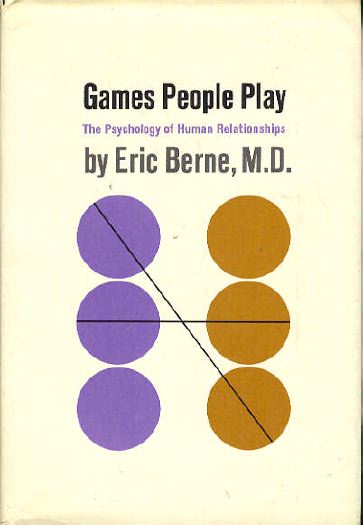
Eric Berne's Games People Play and social media


I've been busy working on several papers lately... blogging's been sparse at best... here's the first of three of the papers... reading notes on Eric Berne's notion of the transaction and the emotional "stroke"... must rest...

From the reading notes:
Eric Berne's Games People Play, popular during its time but no less fascinating and perhaps even relevant to a theory of mediated interaction, is a wonderful reading of the transactions of emotional "strokes" among people interacting with one another. For Berne, human interaction is always engaged in this fundamental exchange (his theory is exchangist, I think), one that seems to have an effect on the body and on personal well-being as well as having its obvious effect on emotional and psychological dispositions. Though we would have to conjecture as to how human interaction can even communicate with biological systems, I see no reason to so here: it's pretty obvious that we are capable of making each other feel good, as we're capable of truly stressing each other out also. That our moods affect our health is well, just as obvious.

What then of the interactions that occur when we're not face to face? What of Berne's stroke? Let's, for the challenge of it, take this fuzzy but genuine insight, this notion that we communicate in order to provision ourselves and others with a feeling of membership and well-being that has no content itself but is instead the subtext of all content of communication, and map its transposition into mediated social interaction.


Reading Notes: Eric Berne's Games People Play PDF, 17 pages. Eric Berne's work on transactional analysis has long fascinated me for its insights into a dimension of interaction that involves basic emotional acknowledgment and recognition: a dimension that would seem diminished by the online interactions and communication that occur without face to face transactions, but which might nonetheless motivate our interactions nonetheless. If it were the case that online interactions attempt to get at the emotional stuff of life that's not immediately present, perhaps through substitute signs, gestures, the use of etiquette or other displacements and substitions, then we could claim that the online world is thin, but offers promise. A lot can be done with ASCII.

All my reading notes are here.

Technorati tags: , , , , , , , , , , , , , , , , , , , , , , , , , ,

Labels: , , , , , , , ,

Friday, October 13, 2006

YouTube: videos are signs, watching is social

Marshall McLuhan, in Understanding Media, writes:

"What we are considering here, however, are the psychic and social consequences of the designs or patterns as they amplify or accelerate existing processes. For the 'message' of any medium or technology is the change of scale or pace or pattern that it introduces into human affairs."

To say that YouTube is not just video hosting or video watching is stating the obvious. The social participation YouTube gets in the video posting, commenting, rating, and circulating is what made it the killer app of hosted video. It is precisely YouTube's popularity that set it apart, and earned it the ability command a huge acquisition fee (read: head count. It was the audience head count, which to Google looked impressively like loyalty, and they may be right, which is why they'll leave it as YouTube for a while and keep their little "video NEW!" link sandwiched between images and news)...

I asked in a recent post what the content of YouTube is, using McLuhan's formula that a medium's content is a previous medium: "This fact, characteristic of all media, means that the 'content' of any medium is always another medium. The content of writing is speech, just as the written word is the content of print, and print is the content of the telegraph.” Then if the content of YouTube is television, its value was measured in terms of audience share (not advertising or programming quality). YouTube was clearly the biggest of the online video networks.

If the content of YouTube was television, but modified because it is online, then its formal content was television, its content as substance is viewers (users). And why is this so important? Because it would be a mistake to see YouTube in terms of its core value proposition: watching video. YouTube is a communication medium, and its real value lies in providing a marketplace "in" which people gather to pass around videos they like. "Watch this, you'll like it" is conversation. It's a statement, and YouTube is full of them. Look up Robin Williams and the first page of results are all the same 2 min and 19 second clip of Mr Williams doing a Scotsman inventing Golf. Why? Because posting is, as we learned from blogging, the fundamental act of communicating. Not reading. Not watching. (Not listening!)

This will all get more interesting as we look at the nature of utterances and communication involving video as reference. We need to compare YouTube and related phenomena to the blogosphere and to blogging. Ask yourself, what is it to refer to a cultural commodity or object, in a statement addressed to friends (or anonymously, to the world). What is that act? Is it a "look at this" act or is it a "look at me" act?

Or is it a "look at me looking at this" act? Let's suppose that the videos on YouTube are like commodities, and that they have the sign value that we associate with fast cars, exclusive brands, and other status symbols. I'm not suggesting of course that some YouTube videos better brands than others — videos aren't brands. I'm suggesting that videos signify social relations.

Videos on YouTube, because they are on YouTube, accrue social significance. That a person wants to share a video with somebody, be it by telling a friend or by posting, or by commenting, means that person likes it. And wants to communicate that like. In a "public" setting, identifying with a commodity carries social connotations. I'm into guitar rock. Or stand up. Check out these Bush out-takes. etc. Each video, in addition to its own content, has a reflective signification also: to like something is a reflection of my likes. The particular (video) makes a general reference (this is my taste). That's the social move. Association with videos can now become social, using the commodity form, as other commodities are social (the status symbols mentioned above). And they're free! Fast! And the consumption of them is ephemeral, and it doesn't oblige anyone to post one back, or to applaud, even to publicly agree.

The social works in online marketplaces like this by establishing a communicable interest between a user and his or her selections (books, videos, music, blogs, etc). If the interest were personal only, it wouldn't need to be communicable. It could just make sense to the person and end there. Its communicability is a sign that it's social. But in each medium, in each application (social software site, community, marketplace, etc) the site has to successfully create an audience/public, and successfully enable the linking of user to interests, and communication of these selections to individuals, groups, and the audience at large. One cannot really wait for the other. Hence the importance of viral marketing, and hence the advantage that has returned to first movers.

Our next investigation ought to be into the changing nature of sign value, of commodities as form and of our relations to each other through these mediators.


Technorati tags:
,
,
,
,
,
,
,
,
,
,
,
,
,
,
,
,
,

Labels: , , , , , , , , , , , , , , ,

Monday, October 09, 2006

Marshall McLuhan on YouTube

There's a great scene in Woody Allen's Annie Hall in which Allen, overhearing a guy in line for a movie refer to Marshall McLuhan, produces McLuhan with the words "as a matter of fact, I have Marshall McLuhan right here." It's a hilarious bit of comedy. I can't produce McLuhan, but I did find him on YouTube.com. I looked for him on YouTube because I wanted to quote McLuhan's theory that every medium has a prior medium as its content. I've been thinking about which medium YouTube has as its prior content (more on this soon). To find McLuhan as content on YouTube, is, well, a bit Annie Hall... (sorry, it's not the *real* McLuhan but only a trailer for a History channel special... the comparison deepens... is the internet a parallel medium to tv? Is an actor playing mcluhan in a video on youtube about a television program about a man who said the content of television is theater a simulation of the real thing quoted in a communication medium or a message circulated in the mass media sampled by a consumer and posted to the mini media or a marketing ploy by the mass media or is it simply the content of my post? things get strange in the mediated world...)

So, which medium is the content of YouTube?

"The electric light is pure information. It is a medium without a message, as it were, unless it is used to spell out some verbal ad or name. This fact, characteristic of all media, means that the 'content' of any medium is always another medium. The content of writing is speech, just as the written word is the content of print, and print is the content of the telegraph." Understanding Media, p 8.


Technorati tags: ,
,
,
,
,
,
,
,
,
,
,
,
,
,

,
,

Labels: , , , , , , , , , , , , , , ,

Thursday, September 21, 2006

Alfred Schutz, F2F, Social Software, and Streams of Consciousness


“If I wish to observe one of my own lived experiences, I must perform a reflective Act of attention. But in this case, what I will behold is a past experience, not one presently occurring. Since this holds true for all Acts of attention to my own experiences, I know it holds true for the other person as well. You are in the same position as I am: you can observe only your past, already-lived-through experiences. Now, whenever I have an experience of you, this is still my own experience. However, this experience, while uniquely my own, still has its signitively grasped intentional object, a lived experience of yours which you are having at this very moment. In order to observe a lived experience of my own, I must attend to it reflectively. By no means, however, need I attend reflectively to my lived experience of you in order to observe your lived experience. On the contrary, by merely “looking” I can grasp even those of your lived experiences which you have not yet noticed and which are for you still prephenomenal and undifferentiated. This means that, whereas I can observe my own lived experiences only after they are over and done with. I can observe yours as they actually take place. This in turn implies that you and I are in a specific sense “simultaneous,” that we “coexist,” that our respective streams of consciousness intersect. To be sure, these are merely images and are inadequate since they are spatial. However, recourse to spatial imagery at this point is deeply rooted. We are concerned with the synchronism of two streams of consciousness here, my own and yours. In trying to understand this synchronism we can hardly ignore the fact that when you and I are in the natural attitude we perceive ourselves and each other as psychophysical unities.” Alfred Schutz, The Phenomenology of the Social World, 103


  • How important is simultaneity to meaning?

  • How important is it to interaction?

  • How important is it for the "binding" that occurs between interactants when they are in a cooperative type of interaction?

  • How important is it for the exchange of truth, for displays and confirmations of sincerity and authenticity, between interactants?

  • Does culture change when we participate in asynchronous activities, when our interactions involve less actual being together, less coordination of our interaction in shared space and time, less in terms of getting on the same page emotionally, or of creating a mood, disposition, and common attitude?

  • How critical is this moment of shared stream of consciousness, as described here by Schutz, to the production of human relations?

  • How much of it can be leveraged as a basis of interaction when interaction cannot be face to face and must be mediated? Or is every asynchronous and technically-mediated interaction a tiny death, a departure from home, a lesser version of the real human experience?

  • As it is in the philosophical duel between Isabbelle Huppert and Lily Tomlin/Dustin Hoffman in the film I Heart Huckabees, the question (or one question) seems to be: are we all connected, or is there an infinitessimally small but ever-present gap and space between us? Does the shared stream of consciousness described here really happen, or does it only seem to happen?


Technorati tags: ,
,
,
,
,
,

,
,
,
,
,
,
,
,
,
,
,
,
,
,
,
,
,

Labels: , , , , , , , , , , , , , ,